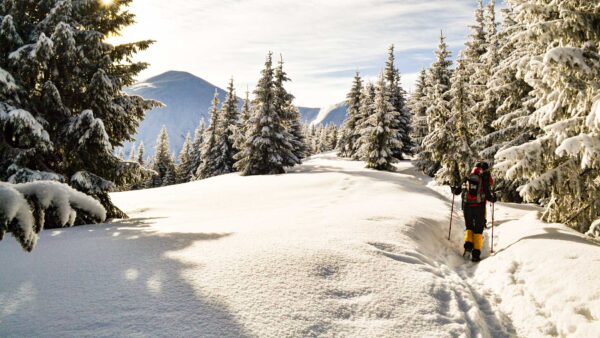
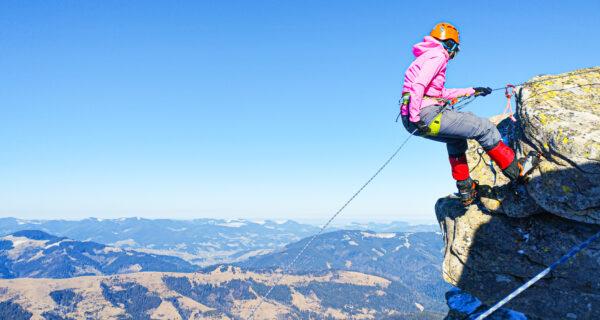
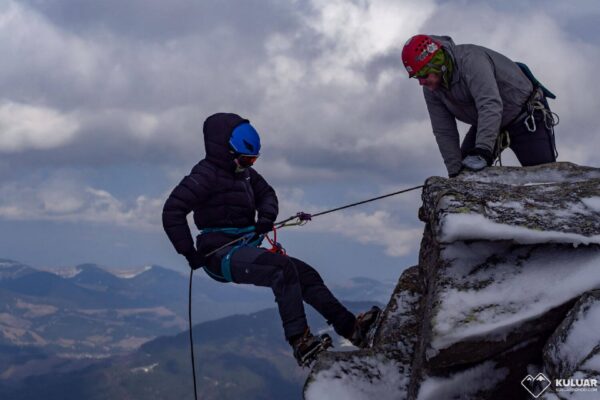
Many tourists only go on summer hikes, avoiding winter for various reasons. But in doing so, they deprive themselves of the incredible beauty and charm that the Carpathian trekking offers in winter. Even the well-known summer routes will look completely different: the contours of the landscape are smoothed out by a thick blanket of snow, the forest is draped in white, and all around there is striking clarity and silence. The sun’s rays play across myriads of crystals, the clear air reveals distant horizons, and the sky takes on such a deep, rich hue that you won’t see during the warmer months. One could talk at length about this beauty, but it’s better to see it once than to hear about it a hundred times…
The winter hiking season in the Carpathians begins in late November or early December and ends around mid- to late April, when the snow has melted on most routes. At altitudes above 1,500 m, snow and winter conditions can persist until May (as was the case, for example, in the spring of 2025). In other words, depending on the weather in any given year, you have almost six months to set off on your first winter hike.
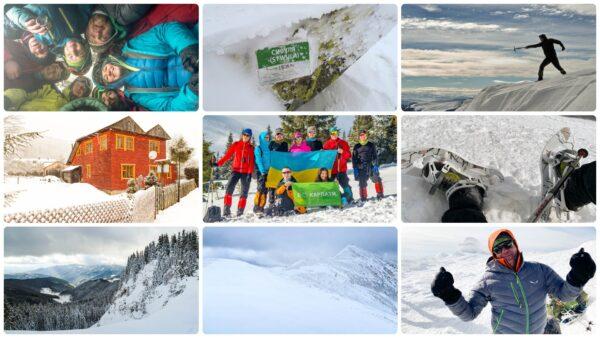
Of course, the weather isn’t always fine. Winter in the Carpathian Mountains is also a time of blizzards, gale-force winds and, occasionally, bitterly cold temperatures.

So what challenges and dangers might tourists encounter when travelling in the Carpathians in winter? Let’s take a look:

However, the human (psychological) factor plays a decisive role:

Having read the above, you might get the impression that it’s not worth going hiking in winter at all. Not at all – the Carpathians in winter are wonderful. You simply need to assess the potential risks, make sensible decisions and follow basic safety rules. You can always choose a hike that suits your abilities and the weather conditions.
What’s more, winter hiking in the mountains is excellent preparation for tackling higher peaks. For example, climbing Hoverla and Petros, combined with mountaineering training, will lay a solid foundation which, together with physical fitness and the right equipment, will enable you to climb your first five-thousanders.
Essentially, the necessary knowledge and skills, adequate physical fitness and mental resilience, thorough planning and the required equipment are all prerequisites for a safe hike.
To ensure your winter visit to the Carpathians is a success and leaves you with fond memories, you need to follow a few simple rules:

Or simply get in touch with the Kuluar travel club, which takes care of most of the above points 🙂

It all depends on your preferences and what you can manage. Hiking trips from cabins and those from tents are completely different.
For a first taste of the winter mountains, we recommend programmes based around mountain huts or a light two-day hike with one night spent in tents. In the first option, you’ll cover just as much ground in a day–and perhaps even more–than you would with heavy rucksacks, but after a day’s walking you’ll have the chance to dry your clothes and boots, have a hot shower and get a proper rest. In the second option, as the hike is short, there is no need to carry a large amount of food, and you won’t have time to get too tired, but at the same time you can experience a winter overnight stay, with cosy evenings by the campfire and an interesting adventure overall.
When it comes to long winter camping trips, they do present certain challenges in terms of daily life at the campsite. Drying clothes and footwear, so-called ‘cold fatigue’ from constantly being in freezing conditions, dampness inside the tent, and many other interesting challenges. Of course, many people enjoy such challenges and find them unforgettable. However, we still recommend starting with a short, straightforward tent trip or trying a winter programme using cabins..
There aren’t as many really good options as you might think, because you need to manage to walk the route along a snow-covered path and get back to somewhere warm before the short winter days draw to a close.
Let’s look at a few popular options as examples:
Pros: an overnight stay at a guesthouse near the start of the route; the path through the woodland is often well-trodden; even in extreme weather conditions, it is still possible to complete most of the route. The ascent to Hoverla and Petros requires good physical fitness, as it covers 17–18 kilometres and involves over 1,100 metres of elevation gain and loss. In most cases, crampons are needed to tackle the steep slope on Petros. But it’s always a pleasure to know that after a day’s exertion, a sauna and a hot tub await you at the farmstead.

The best way to climb Mount Kostrycha is via the red route from the Kryvopil Pass. On the way, after visiting the ancient beech forest and the Vesnarka mountain pasture, we reach the highest point of the ridge – Mount Kostrycha, at an altitude of 1,585 metres. We return via the yellow route, which eventually joins the red route we started our journey on. In winter, this hike can take around 8 hours, including a lunch break.
There are several routes up Mount Kukul, of which two are the most popular: from Zavoyella and Vorokhta. A blue-marked trail leads from Zavoyella to Mount Kukul, the highest point of the ridge. This is the shortest but also the steepest route: a 4.5 km hike, taking about 3 hours, and you’re at the summit. After making a short detour for the sake of interest, we return the same way, or continue along the blue route to Vorokhta for another 9–10 km..
On Mount Pip Ivan, we are greeted by Ukraine’s highest-altitude building – The White Elephant. Back in the 1930s, it was a functioning observatory, but it is currently undergoing renovation, and several rooms have been converted into a rescue post, where mountain rescuers are on duty around the clock. The building got its current name precisely because of how it looks in winter – a thick layer of ice and snow forms on the walls, giving the observatory a whimsical and fairy-tale appearance. We return along the same path, rest, and share our impressions and feelings.


Cottages are all well and good, of course, but is it possible to go camping in winter? Of course, if you have plenty of experience, knowledge and good equipment, there are many options you can plan and undertake. But tourists of that calibre are unlikely to need our advice, so let’s look at some simpler routes for travellers who are just beginning to explore the snow-covered Carpathians. So:
If you fancy spending the night in the warmth, listening to the crackling of the logs in the stove, you’ll need to make an effort, as this place is quite popular and there isn’t any dry wood nearby.

On the second day, we’ll make a radial ascent to two peaks – Parenky and Grofa – which offer magnificent views of the snow-covered Gorgany. On the third day, we’ll descend to the village of Osmoloda via the same route, or, if there’s no risk of avalanches, we can take a wonderful traverse across Mount Grofa.
How about heading to the mountains this year instead of the usual celebrations? In the Carpathians, there’ll be a Christmas tree for New Year too – or rather, a whole snow-covered forest. There’ll also be winter hikes, evenings in a mountain cabin and the chance to start the year in a completely different way to usual.
This year, KULUAR has special New Year’s programmes for this. If you’d like to climb Ukraine’s two highest peaks, you can choose a four-day trek including ascents of Hoverla and Petros. Another option is a three-day hike to Petros from Kvasiv. Here, participants can expect longer treks along snow-covered trails and overnight stays in a simple mountain hut.
That said, public holidays have no bearing whatsoever on the nature of the Carpathians in winter. Strong winds, freezing temperatures and deep snow may still be encountered on the routes. Therefore, the right kit, physical fitness and preparedness for challenging weather conditions remain essential.
If this sort of start to the year takes your fancy, have a look at our New Year’s hikes in the Carpathians and choose your route. After all, you can spend your New Year’s holidays around a festive table at any time, but seeing in the New Year after a winter climb up Petros is a completely different story.
So analyse, think, plan – but not too much... Take the plunge, because the Carpathians in winter are completely different from those in summer, and can offer both a magical experience and a test of your strength and determination. But almost always, if a route is dangerous or difficult under the current conditions, you can find an interesting and safe alternative. And our club will be happy to help with that.
If you're heading to the mountains, go with Kuluar!
Author of the article: Ivan Kucheryavyi, team leader in the Carpathians