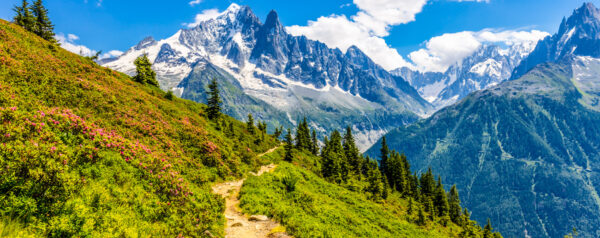
Mont Blanc is the highest peak in the Alps and Western Europe, and is the dream goal of many mountain lovers and climbers from around the world. Climbing this peak is a part of the "Seven Summits" program, but not everyone will dare to do it. Therefore, for those who are not yet ready to overcome the difficulties of high altitude and make their way among glacial cracks and eternal snow, there is an easier way to see the peak and the entire surrounding mountain range - to go on a trekking route around Mont Blanc, the Tour du Mont Blanc.


The summit of Mont Blanc is 4,810 meters above sea level and is located on the border of France and Italy. As for the entire massif, part of it also crosses the border with Switzerland. Thus, the track around Mont Blanc passes through the territory of three countries. The good news is that thanks to the existence of a single Schengen area, there is no border control between these countries, so anyone can go on this exciting trek without any obstacles.

The most popular arrival point for anyone wishing to see Mont Blanc is the city of Chamonix in France, which has historically been the cradle of world mountaineering and remains its active center today. Here you will find a well-developed tourist infrastructure: hotels, restaurants, campsites, mountain equipment shops and souvenir shops with authentic local products. The Chamonix Valley offers activities and entertainment for every taste. Here you can enjoy the views from the windows of a spa hotel in the city center, go hiking on mountain trails, and fulfill more extreme dreams, such as climbing, rafting or paragliding.
During the peak tourist season, which is in summer, as well as in the winter months, when Chamonix becomes one of Europe's most famous ski resorts, it is quite easy to get here. Connections to surrounding airports and major cities are very good. The fastest option is to arrive at Geneva Airport, where shuttle buses run almost every hour during the day, which can take you to the bus station in the city center or, for an additional fee, directly to the hotel door. Travel time from Geneva Airport to Mont Blanc is less than two hours.

It is also convenient to get to the foot of the mountain by flying into the Italian cities of Turin or Milan. In this case, you can take a bus to the mountain resort of Courmayeur, located on the other side of the massif, which also offers snow-capped peaks of the Alps. To get from Courmayeur to Chamonix, you need to drive through the famous Tunnel du Mont-Blanc in the mountain, which will take about an hour. For bus passengers, the cost of traveling through the tunnel is included in the ticket price, while owners of their own vehicles will have to pay about 50 euros for one-way travel. There is also a railway station in Chamonix, where trains arrive from Saint-Exupéry Airport in Lyon and other French cities.
It will be hard to get lost in Chamonix itself. Moreover, in the tourist information office you can take printouts of the city plan and the transportation scheme throughout the valley. Here you can get around by local buses (run every half hour), and if you take a "guest card" at your hotel or campsite, the ride will be free. There is also a network of chairlifts and gondolas throughout the valley that run to the best viewpoints and scenic mountain trails.
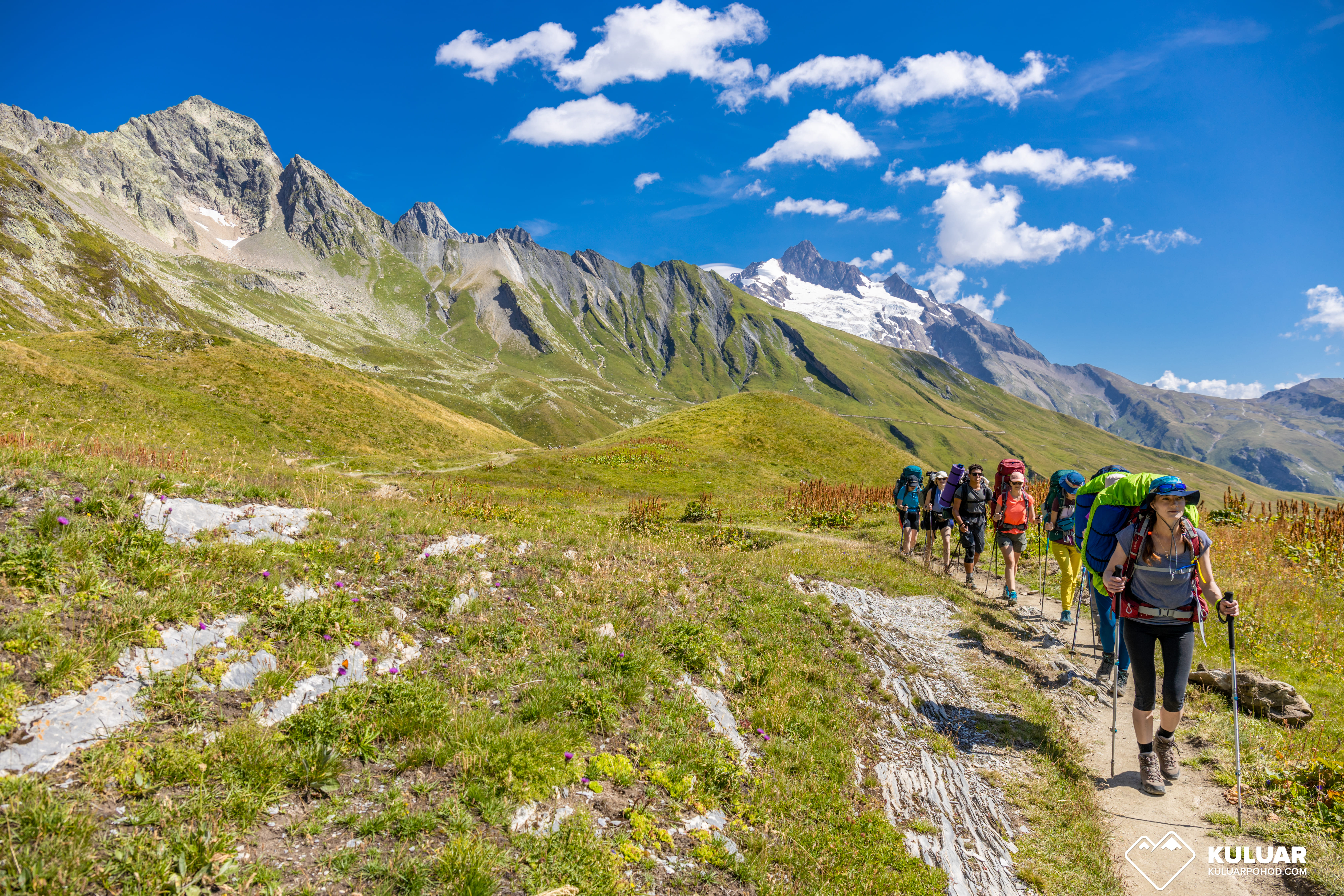
According to numerous ratings of the "top best hiking routes in the world", the track around Mont Blanc confidently takes its place in the top ten. Indeed, the combination of stunning alpine landscapes with easy transport accessibility to the region and well-developed infrastructure has created ideal conditions for the development of mountain tourism. The history of the Tour du Mont Blanc dates back to the 18th century, when Dr Michel-Gabriel Paccard and Jacques Balmat made the first ascent of Mont Blanc on August 8, 1786. Until then, only local hunters and shepherds used the trails through the passes and mountain valleys in the Alps.
The fame of the highest peak in Europe was spreading rapidly around the world, and many people were interested in seeing its snow and glaciers shining with white with their own eyes. Of course, then, as now, not everyone would have dared to climb to the very top, but even people without hiking experience can do it.

The total length of the full ring around Mount Mont Blanc is 170 km with an altitude difference of more than 10,000 m, which requires most tourists to complete the route in about 10–12 days. The highest points of the track are the Col des Fours passes in France and the Fenêtre d'Arpette pass in Switzerland, which are 2665 m above sea level. Also, the Fenêtre d'Arpette pass is considered the most difficult section of the route, as the descent and ascent on both sides are quite steep, the trail sometimes passes over unstable stones and, even with markings, is not always clear. Other passes have less difficult terrain and elevation changes and are easy to hike even at a slow pace during the day.
The circular track can be completed either clockwise or counterclockwise, starting in Chamonix, France, Courmayeur, Italy, or one of the Swiss towns (such as Champex, Trient, or La Fouly). Some segments have alternative routes, where each hiker can choose the one that suits his or her difficulty and preferences: either passing high passes or covering more ground bypassing the massif through small mountain villages with convenient roads. Sometimes it is even possible to catch local transport at the bottom of the track, reducing the route through the valleys to 10-20 km.

For example, in the French part of the route, there is an option to pass the Col de Fours pass, which can be quite uncomfortable in the presence of snow at the beginning of the season, or even dangerous in rainy weather during a thunderstorm. In this case, it is recommended to take a shuttle bus that runs between the Ville des Glaciers farm and the village of Les Chapieux and climb from there to the next pass, Col du Bonhomme. Similarly, instead of the Col du Tricot pass, you can take a bus through the valley from Les Contamines to Bionassy, and in Switzerland, you can cut the boring kilometers through the forest between Champex and La Fouly. Thanks to such transfers, some travelers reduce the length of the Tour de Mont Blanc so much that they complete it in a week instead of 10 days or even in 4–5 days.
Although most of the route is well-marked with signposts and markings on rocks, having a navigator and a map is still necessary, as well as understanding where you plan to spend the next night, what option you have, and how long it will take you to get there. On the one hand, the track around Mont Blanc is a very popular tourist route, accessible to a wide range of hikers. But on the other hand, these are still real mountains that require a serious approach to preparation and planning.
The high season for trekking on the Tour du Mont Blanc lasts from July to August. Booking mountain shelters on the route at this time is quite a challenge, especially if the group consists of more than 2 people. Usually, early booking opens at the beginning of the year, back in January, and fills up pretty quickly. It is almost impossible to find free places before the start of the season, because the shelters put everyone on a waiting list and even if someone refuses to take their place, others instantly get there.
The cost of an overnight stay here can range from 60 to 100 euros for accommodation in dormitory rooms for 6–10 people, or 150–200 euros in a double room, if available. As a rule, the price includes half-board meals: breakfast and dinner according to the shelter's schedule, as well as the possibility to order a lunch box for the day. This option of overnight stays, if the budget allows, and you manage to find free places on the selected dates, allows you to go through the route in the most relaxed way, without bothering yourself with camping equipment and cooking.
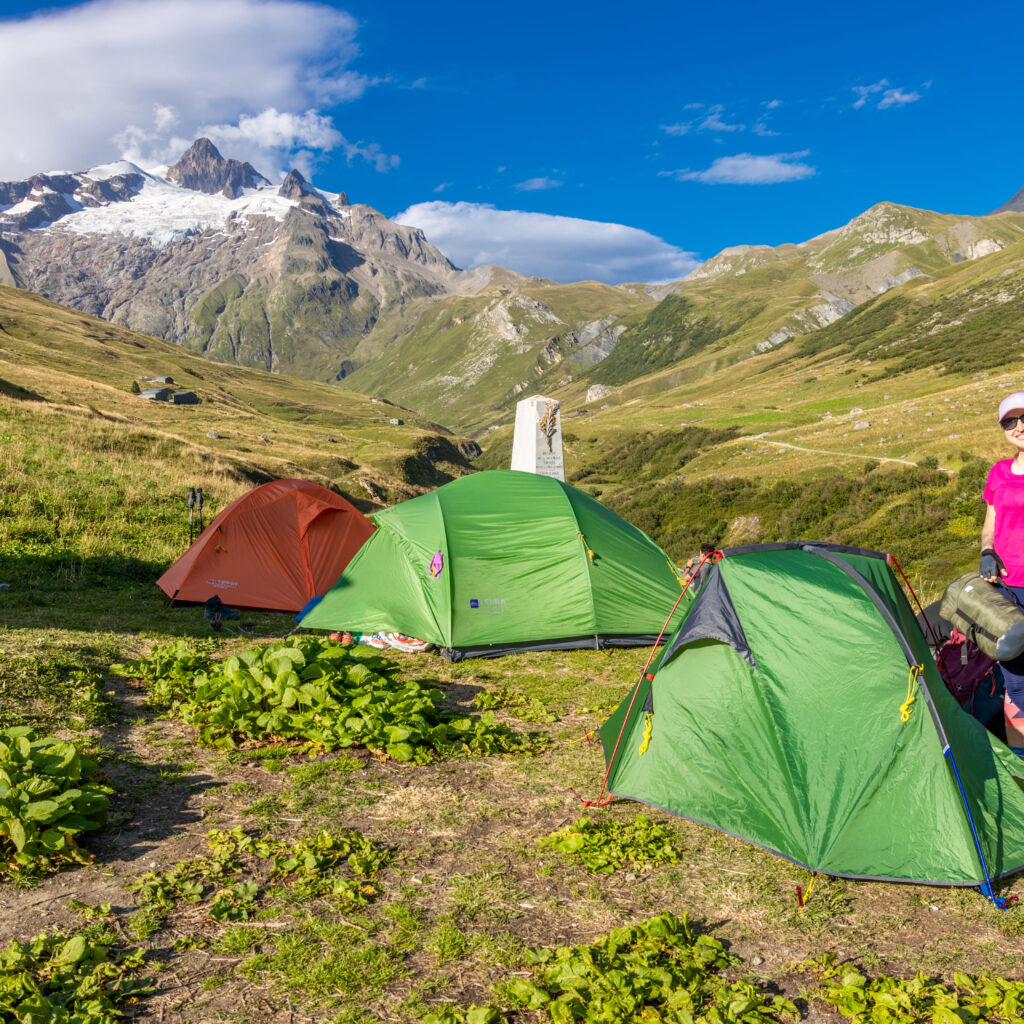
Another option for accommodation on the Tour du Mont Blanc route is campsites, which differ in terms of comfort and infrastructure. Campsites in the Chamonix and Courmayeur valleys have hot showers, electricity, and Wi-Fi. Wild "camps" or lawns near shelters have only access to a water source and toilets. If you are hiking the full route through high passes, there is no way to avoid spending the night in wild campsites. But there is a favorable compromise that allows you not to worry about the availability of places in shelters and at the same time get rid of carrying heavy backpacks through the passes in the Alps - this is our Mont Blanc Kuluar Tour without heavy backpacks. What's its highlight?
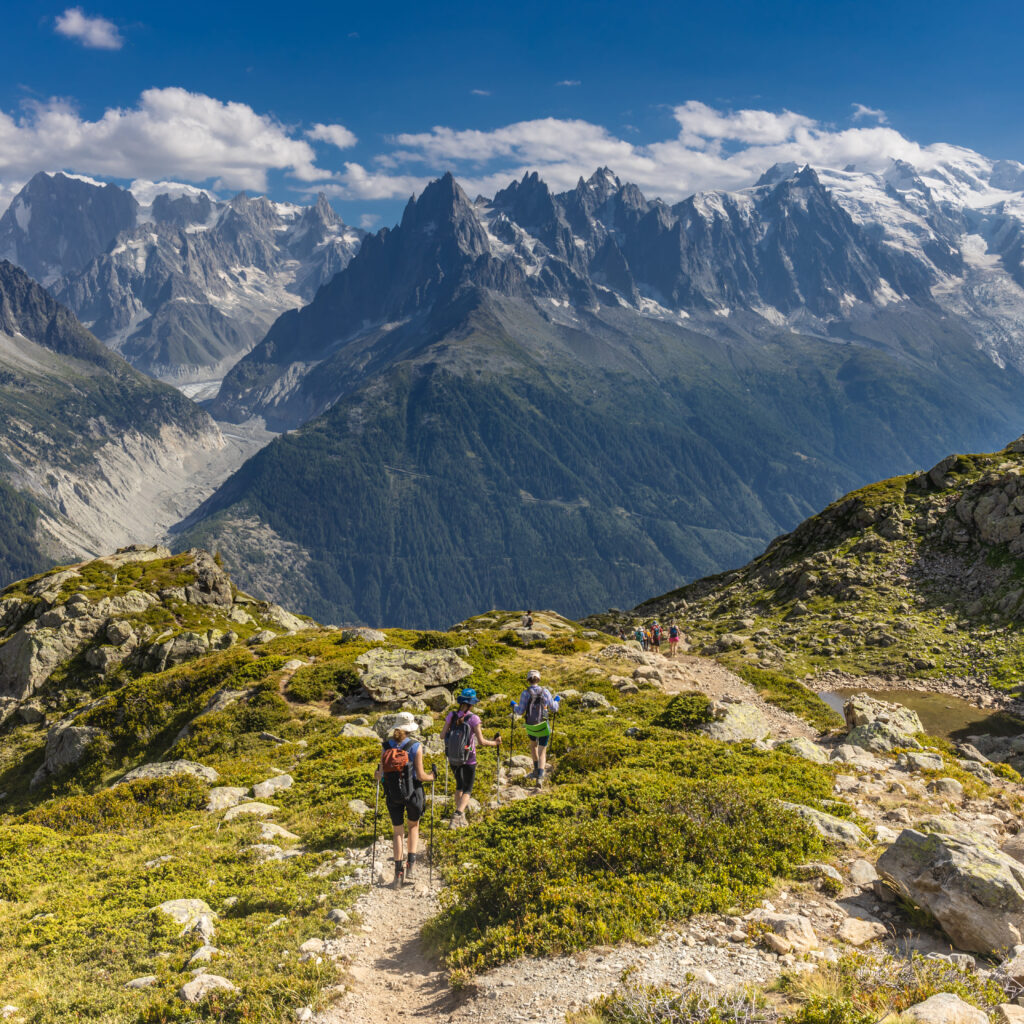
Comfortable accommodation is ensured by the fact that during the track we are based first in a well-equipped campsite in Courmayeur. From here, we make radial exits to the Val Veni and Val Ferret valleys, exploring the entire Italian side of the Mont Blanc massif and such famous peaks as Grandes Jorasses, Dent du Géant, Aiguille des Glaciers and others. Before we start climbing the mountains, we will take eco-friendly buses, which are launched by local authorities in the valley to relieve traffic and preserve the environment. These buses run from the bus stop right next to the campsite through the city center throughout the tourist season every half hour.
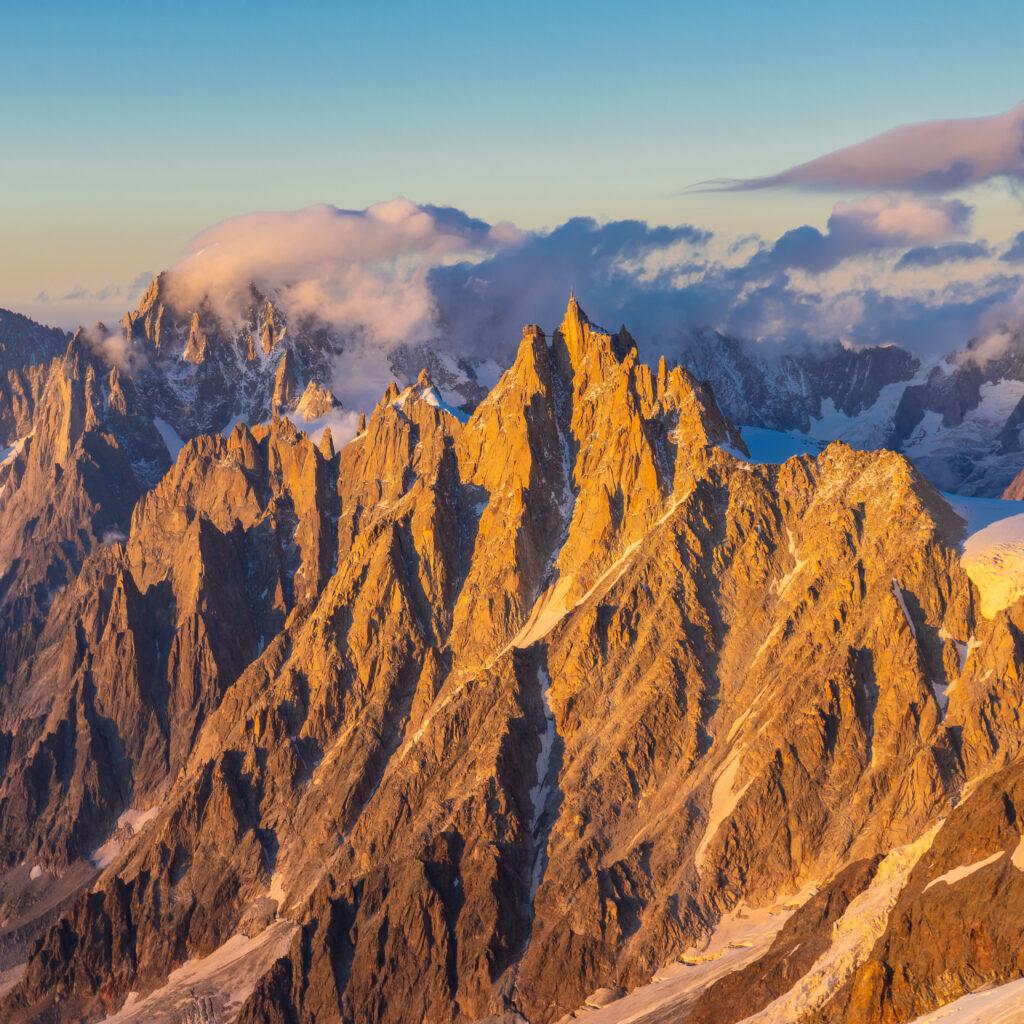
Three days later, we travel by bus through the tunnel under Mont Blanc from Courmayeur to Chamonix. Here, staying in a comfortable campsite for several days, we hike radially through the most picturesque corners of the valley, visiting the Argentiere glacier, the Mer de Glace ice cave, the Col de Balme pass on the border with Switzerland, and climbing to the viewpoints of the Brevent and Aiguille du Midi peaks. In Chamonix, for easier access to the upper trails, we use mountain lifts, which significantly save time and effort and allow you to get more positive impressions of the track during the day.
For those who want to feel a little more stress and show their perseverance in overcoming difficulties while passing the passes, we offer the option of a track around Mont Blanc with backpacks.
It also starts in Courmayeur, where, after a group meeting and the first night in a comfortable campsite, we set off on an adventure, climbing the 2516-meter-high Col de la Seine. Beyond this pass, France awaits us and the small farm of Ville de Glaix, next to which we will set up a wild camp for the next night. Further, the route runs through the Col de Fours and Col du Bonnom passes, where we spend the night near mountain shelters on grassy glades with magnificent views.

After the descent, we get back to civilization, take a shower at the Le Contamine campsite and buy food for the next part of the track. In the morning, after a short bus ride to the beginning of the trail, we get to Chamonix through another mountain pass. From this point on, the program completely converges with the option of a tour around Mont Blanc without heavy backpacks, because it would be simply not rational not to use the excellent transport and ski lifts in Chamonix.

Despite the fact that this trekking route is quite simple and does not take place at high altitudes, it is still necessary to properly prepare high-quality equipment so that its inconvenience or failure does not spoil the experience of the trip.
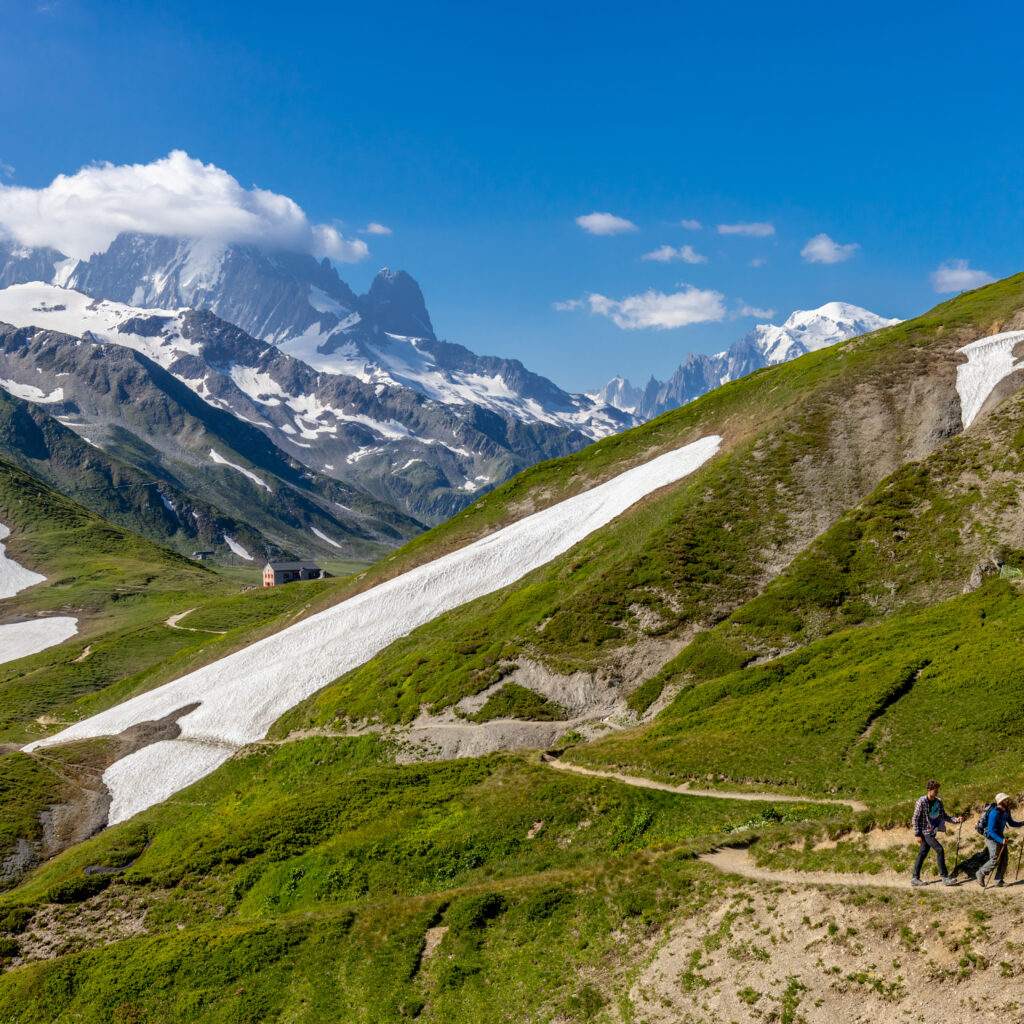
Every year, since 2003, an ultramarathon mountain race has been held along the Tour du Mont Blanc route in late August or early September. It gathers thousands of athletes from all over the world who are in love with mountain running. Since its inception, the UTMB race has become the most prestigious and coveted for anyone who has ever been fond of trail running. The full distance is 100 miles (a 170 km lap with 10,000 m of elevation gain), and there are several shorter distance options: a 100 km half lap, or 50, 42 or 20 km options for those who want to test their strength in preparation for the main event. Currently, the UTMB speed record is less than 20 hours, and the maximum time limit for the course is 46 and a half hours.
To participate in the race, you need to fulfill a number of requirements, such as covering a similar distance to the declared distance to assign the so-called "index" of UTMB, as well as participate in one of the series' competitions around the world. Each participation gives points in the form of "Running stones", which are used as a chance in the lottery to register for the final race. After all, the number of applications is several times higher than the physical ability of the organizers to admit so many people to the race.
Kilian Jornet Burgada, a well-known top climber and trail runner, is a multiple winner of the Ultra Trail du Mont Blanc and a record holder of the course. He also set the world speed record for climbing Mont Blanc - 4 hours and 57 minutes, despite the fact that he ascended and descended without using a tram, but from the lower point in Chamonix.

For those who are attracted to the summit of Mount Mont Blanc, there are several climbing options that differ slightly in logistics, length, and difficulty. We recommend that beginners try the following three.
Classical climbing from France - along the Goûter Route. It is the most popular way to climb Mont Blanc, used by several thousand climbers every season. The route begins in Chamonix, from where you can take the Tramway du Mont-Blanc mountain train to the Nid'd'Aigle starting point at an altitude of 2372 m and then continue to climb the trail to the Refuge de Tête-Rousse. After that, usually the next day, early in the morning or at night, you need to cross the Grand Couloir section, which is quite dangerous due to frequent rockfalls, and then go to the Goutet shelter along simple, albeit steep, rocks. From the shelter, you will walk on snow and glacier to the top. Depending on the weather conditions, logistics plan and physical condition of the group, this route can take 2-4 days.
Traversee des Trois Monts starts from the Aiguille du Midi cable car station with an overnight stay at the Cosmic shelter. It involves the passage of a bundle of three peaks: Mont Blanc du Tacul (4248 m), Mont Maudit (4465 m) and the main peak Mont Blanc (4810 m). This option is much longer and somewhat more technically challenging than the classic one, but it is also in great demand. Sometimes the Traversee des Trois Monts is combined with the descent of the classic route, thus making a complete traverse of Mont Blanc.

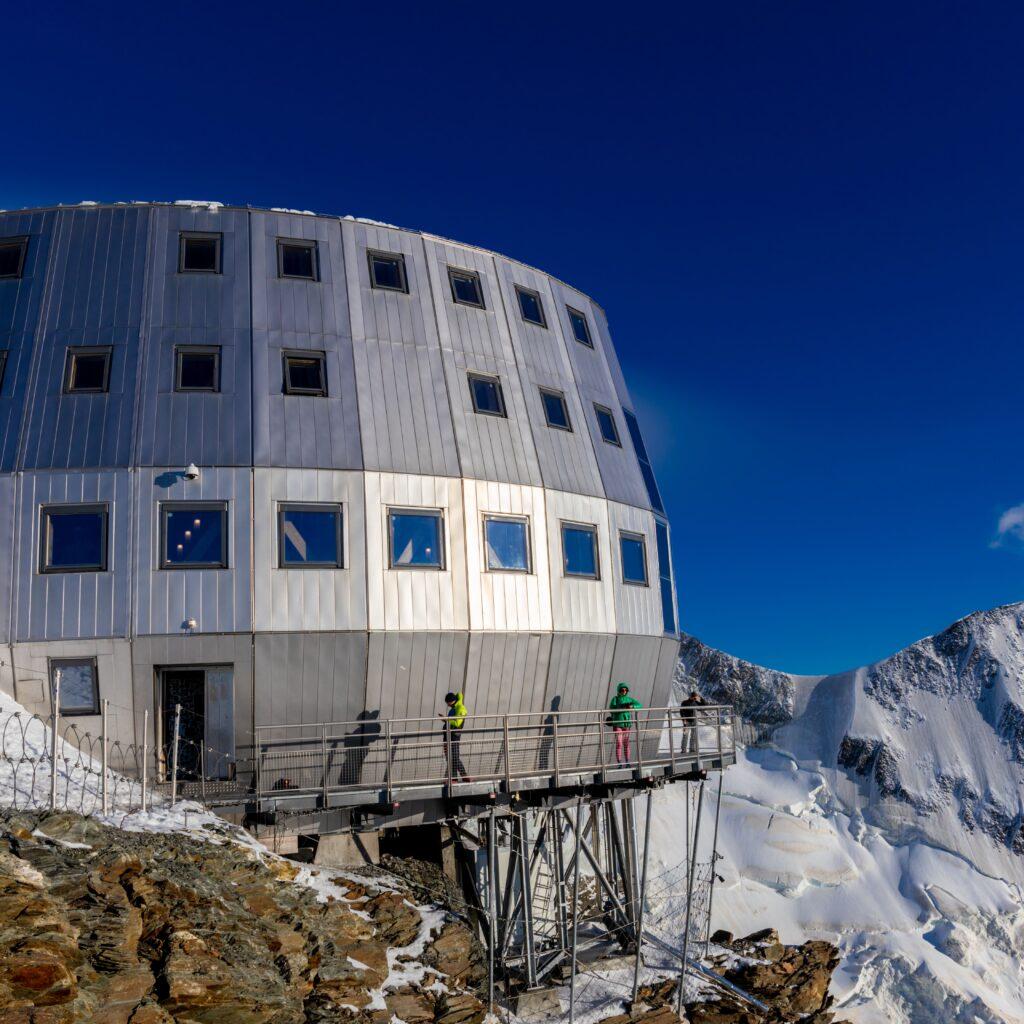
A classic from Italy, from Gonella Hut. After climbing the intermediate saddle Dôme du Goûter further to the top, the path is completely the same as the French classic. The difficulty lies in the length of the route and overcoming the lower part of the glacier, which in certain seasons can be very torn and resemble a real maze of cracks.
KULUAR зinvites you to climb Mont Blanc using any of the three options described above. The groups are led by experienced teamleaders who have been on each of the routes many times and know all the peculiarities of the mountain's condition depending on weather conditions and season.

The season for climbing Mont Blanc lasts throughout the summer. However, despite the fact that the mountain shelters of Tet-Rousse and Goutet start their work from the end of May, at this time you can still expect rather difficult snow conditions on the mountain. Therefore, it is best to plan your ascent after the twentieth of June. During July-August, the amount of snow gradually decreases and in the hottest weeks it is sometimes possible to reach an altitude of 3800 m even without using crampons, which are needed only on the glacier and snow ridges. However, the weather on Mont Blanc is quite changeable and sudden snowfalls can occur above 3000 meters even in the middle of summer, so you should be prepared for such a "surprise".

In early fall, the weather in the Alps can still be quite stable and favorable for climbing. The shelters on Mont Blanc continue to operate until mid- to late September, and climbing the classic route is still available at this time. You should be prepared for lower temperatures and possibly stronger winds than in summer, but there are usually no critical changes in weather conditions at this time.
Winter climbing Mont Blanc is much more difficult and demanding, so it is mostly the prerogative of mountain guides and professional climbers, who sometimes ascend and descend on skis or via non-standard routes. For a tourist group without experience, such extreme activities are not recommended.
Whatever you choose, climbing or trekking, the surrounding scenery will not leave you indifferent. Be sure that you will find yourself in the heart of the Alps and see breathtaking views: flowering valleys, impressive pyramids of rocky peaks and glittering glaciers covered with cracks. All this is on an unforgettable trip to Mount Mont Blanc.

Author of the article: Yulia Yurasova, Team Leader in South America