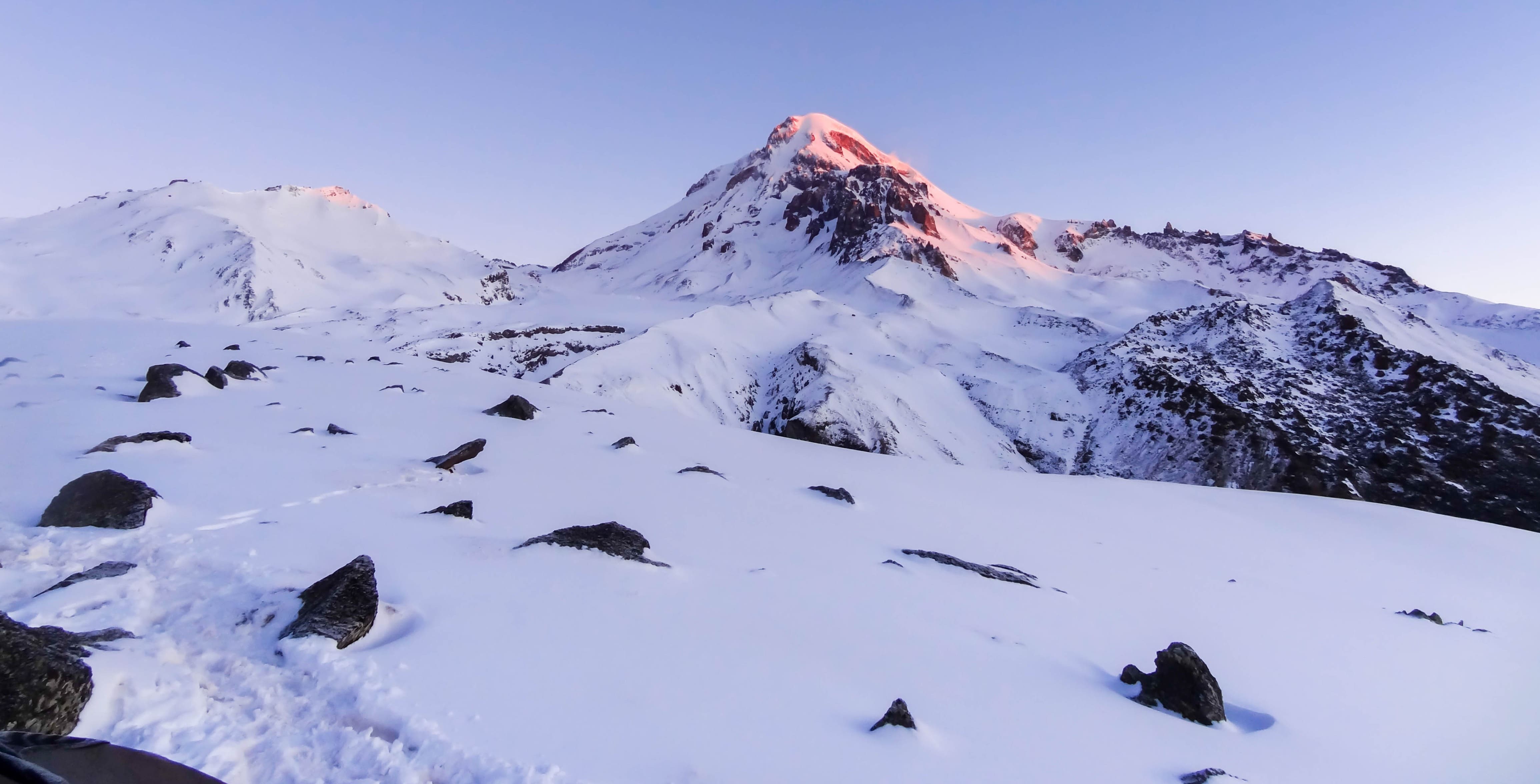

The Caucasus ranges attract tourists from all over the world like a magnet. Even those who have been lucky enough to visit Nepal and see Mount Everest with their own eyes never cease to long for the Caucasus mountains! And it's no wonder, because the geographical and cultural characters of Europe and Asia are combined here. There are wild hiking trails among the relict forests of the Ice Age, secret thermal springs and flowering alpine meadows... And in the bosom of eternal snow there are routes leading to peaks over 4-5 thousand meters above sea level. One of the most tempting and accessible peaks in the Caucasus, and therefore the most popular, is the Kazbek volcano. That's why we are happy to tell you about this mountain and invite you to climb the iconic peak with the KULUAR club team leaders.

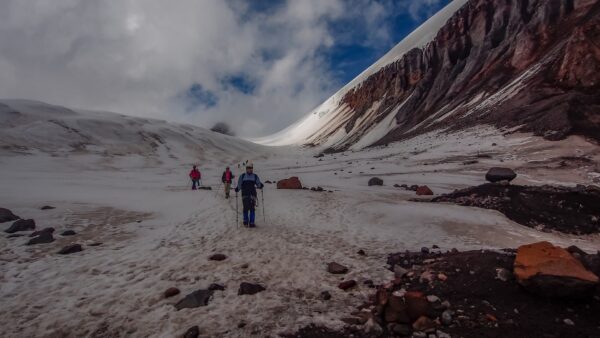
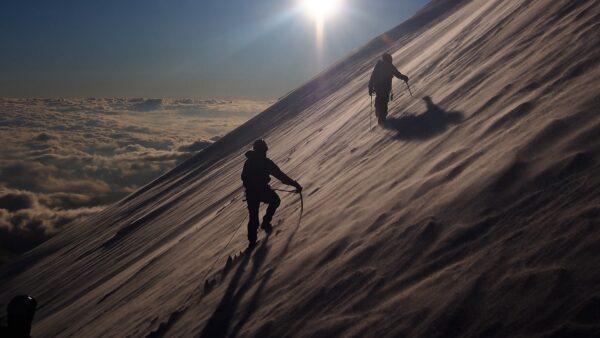

Brief background. Kazbek is an inactive (the last eruption was more than 2750 years ago) two-sided stratovolcano that props up the skies of Georgia and russia. Accordingly, routes to the top lead from both countries. The mountain is covered with eternal snow and glaciers, so climbing to the peak requires climbing equipment and the ability to use it. What is the absolute height of Kazbek? The western peak is lower (approximately 5015 meters), so the eastern peak is taken into account. Official Georgian sources indicate that its highest point is 5054 m, while international mountaineering maps show 5033 m. Satellite measurements also fluctuate between these values. This 21-meter difference does not affect the important "regalia" for climbers - the title of five-thousanders and the status of the second-highest peak in Georgia (after Shkhara).
More importantly, for beginner climbers, Kazbek is ideally suited to the role of the first 5,000-meter peak! The Georgian route, which has a difficulty category of 2A, makes it possible to gain mountaineering experience, get acquainted with the height and see breathtaking views of the majestic Caucasus without too much difficulty.
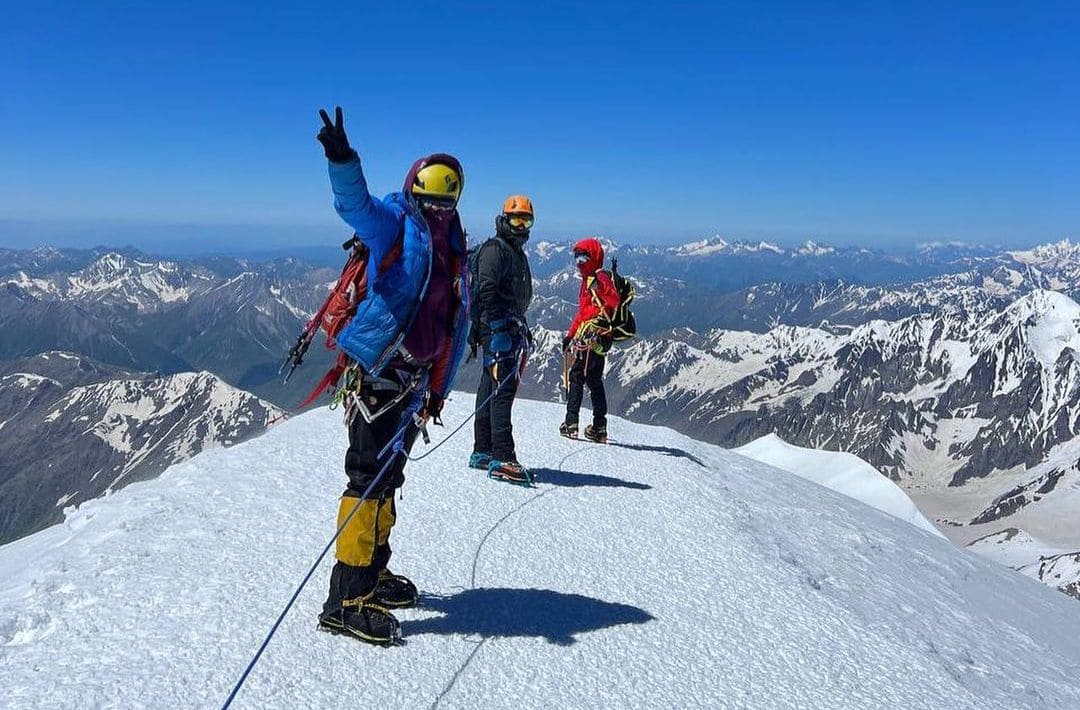
Our experience shows that for the first real mountaineering five-thousanders you should go to Kazbek
We do not consider the approach to this volcanic mountain from North Ossetia as long as the terrorist country of the Russian Federation exists on the world map. And, frankly, it is not as interesting from a tourism point of view as the track from the sunny, hospitable Sakartvelo. We'll look at the route below, but for now, let's talk about the road to Mount Kazbek, how to get to the foot, and what you can see in the area.
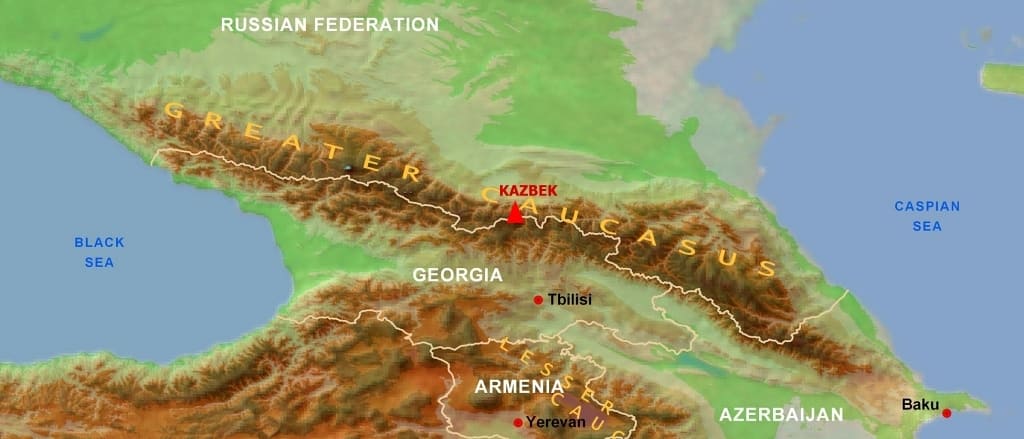
Kazbek is located in the north of Georgia, right on the border with Russia. The Georgian side is definitely the best place to get acquainted with the mountain - it's safer, more picturesque and allows you to feel the real atmosphere of the Caucasus
The most convenient way to start is from Tbilisi, because most planes arrive at the Shota Rustaveli International Airport and it is closer than from Batumi or Kutaisi. And you need to go to the resort village of Stepantsminda (Kazbegi), which will take 3-4 hours to reach. This is a very popular destination, so it's easy to get there from the capital not only by taxi but also by public transport - minibuses run regularly from the bus station near Didube metro station. For our groups, we at KULUAR organize a comfortable transfer from Tbilisi, which is very convenient, and you can stop at the viewpoints along the way if you wish.
Usually, upon arrival in Stepantsminda, climbers stay overnight (our groups also) to rest after the journey and get used to the altitude, as the settlement is located at 1700 meters above sea level. This is where the journey to Kazbek begins... It is convenient that you can start not only on foot. In order not to waste time and energy, the groups use taxis to take them from the center of Stepantsminda to the Trinity Church of Gergeti, which is a climb to an altitude of about 2170 meters. That is, you don't have to be a mountaineer or mountain climber to see the famous five-thousand meter high peak from the outside and get to its foot. This way, we approached the sights of the region smoothly.
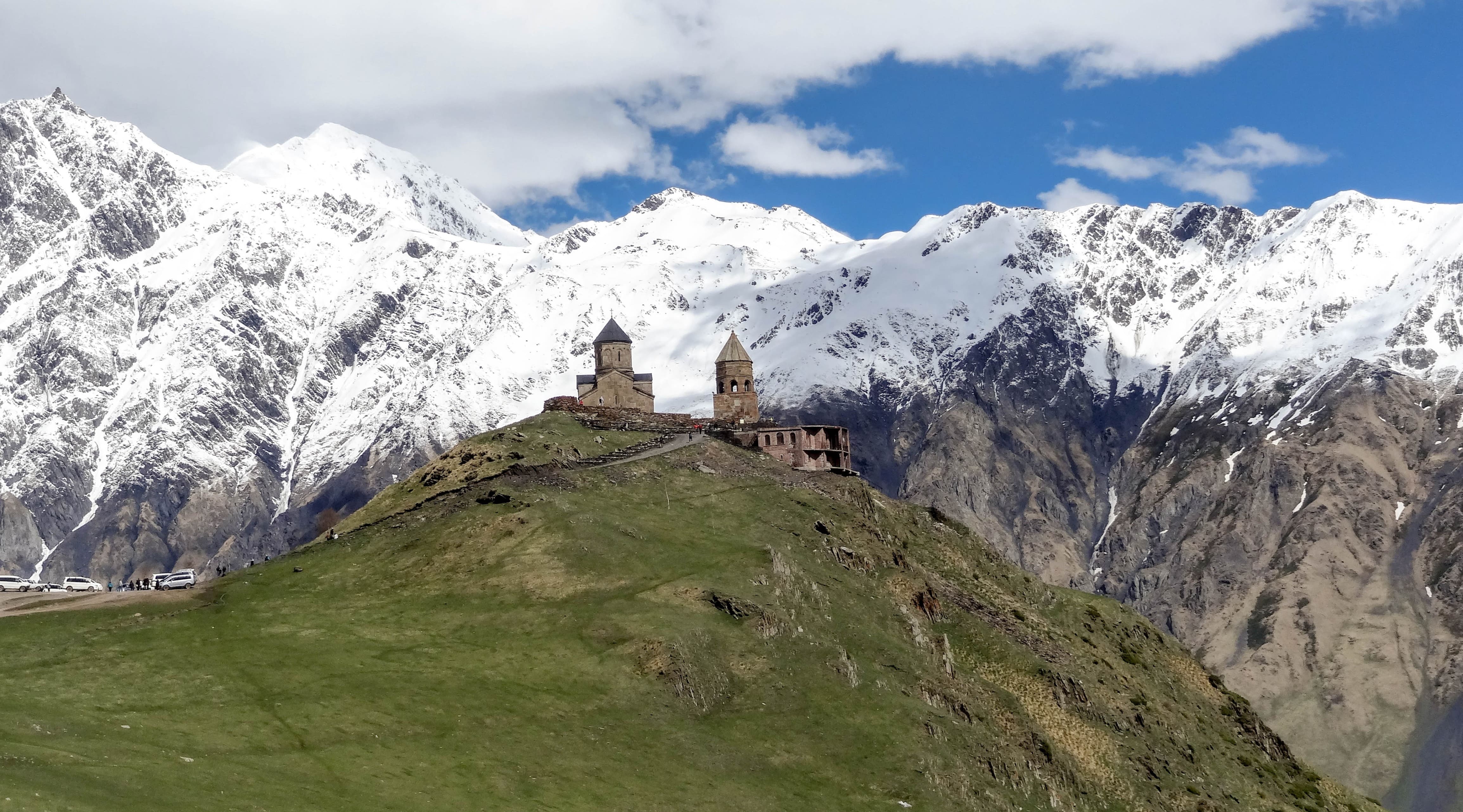
A view of the Gergeti temple from the trail leading up to Kazbek
Since we're talking about the Gergeti Church, we'll start with it, and we'll also tell you about a few locations that we recommend visiting before you get to the top (again, to get used to the mountain climate more smoothly).
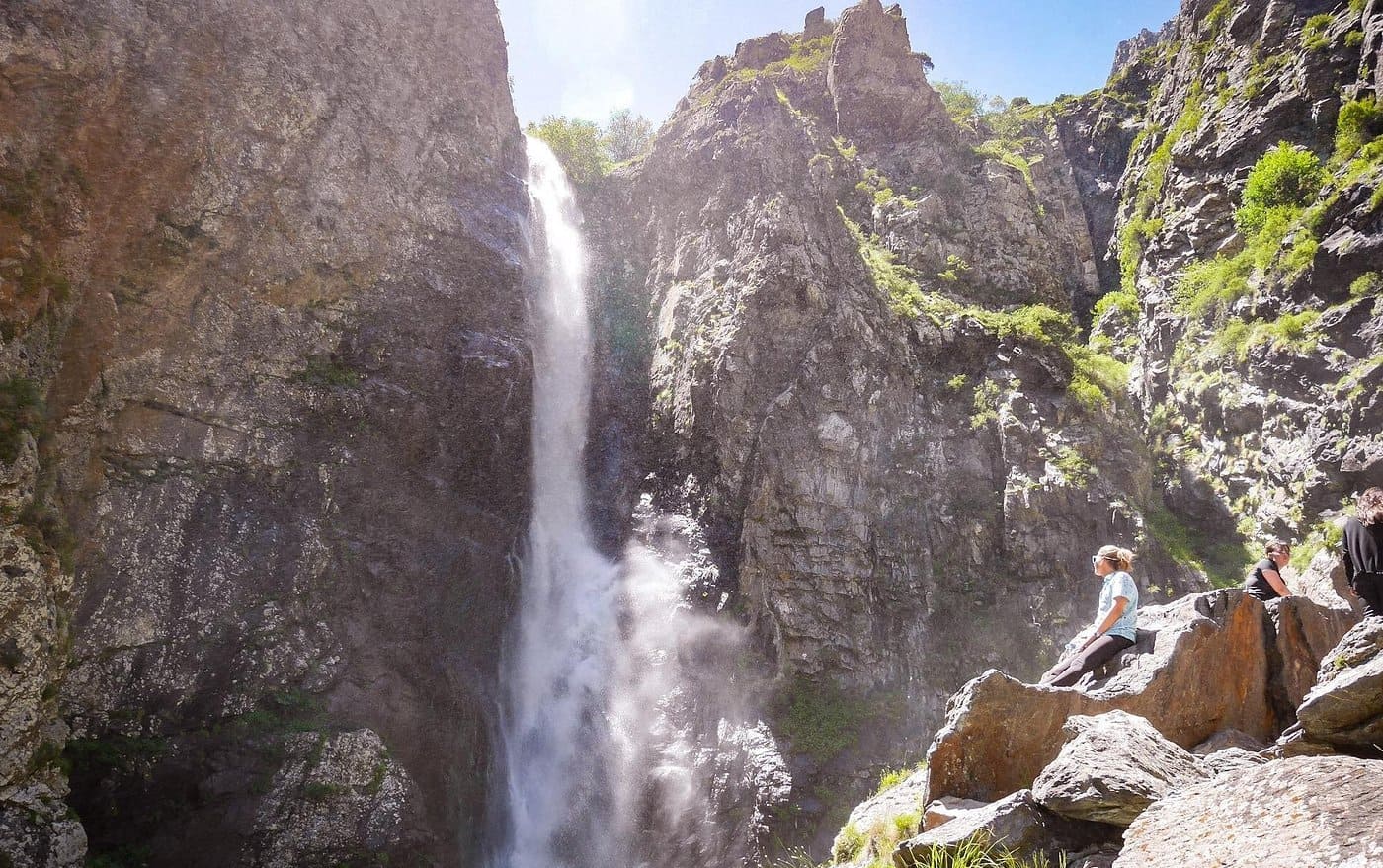
Undoubtedly, there are many amazing natural beauties in the neighborhood, but it is the top of Kazbek that attracts us the most...
There are 3 main routes of different difficulty categories leading to the summit. The track from North Ossetia is classified as 2B and, as mentioned above, we don't even look at it. From the Georgian side, Kazbek can be climbed via the classic 2A route or its more difficult version, which is classified as 3B. The latter option is not suitable for beginners and climbers with little experience, so we'll talk about the classics below.
Interesting fact. The history of the first ascent of Mount Kazbek is due to the Buzurtanov family of Ingushetia. Only the date of the first officially registered peak reaching by three English climbers is known for certain - June 18, 1868. However, this was not a pioneering achievement in the full sense, because the foreign guests were guided by four local residents (Ingush from the village of Gvileti) who already knew the way quite well. One of these Ingush is Tsogol Buzurtanov. According to Georgian legend, it was his father, Joseph Buzurtanov, the "hunter of turs," who was the first to set foot on the top of Kazbek. By the way, Tsogol and his sons Yani, Mussa, and Isaac repeatedly guided other mountain climbers in the following years.
It is clear that "2A" is an empty sound for those who are not familiar with the categorization of climbing routes. Therefore, for the sake of general understanding, let us note what factors make climbing a peak difficult:

The safest way to cross the Gergeti Glacier is in good weather and when it is "open," i.e. not covered with snow, so the cracks are clearly visible
In other words, Kazbek is not a "walking" volcano, as the exotic Kilimanjaro or the legendary Ararat are called (cat. fig. 1B). Unlike these five-thousanders, where trekking poles are enough for climbers, the Georgian peak requires a set of snow and ice equipment and basic mountaineering skills.
Another important point: as in any large mountain, the difficulty of the route depends on the season and weather. Even Kazbek in May and August are two completely different mountains, not to mention in winter. Can you find 5 differences? 😉
Why are we talking about this? When planning a vacation to climb Kazbek, take into account not only the difficulty category of the route, but also the seasonal features (the easiest climb is in August). If you do not have enough experience, it is better to take care of choosing a program in advance, where the factors of difficulty and danger will be minimized. We can say this from experience, because we have developed a corresponding offer - the Backstage tour "Climbing Kazbek in comfort". It increases the chances of successfully reaching the summit: an experienced team leader leading a group of 1-3 participants (no more), high-quality acclimatization and training in snow and ice techniques, saving energy by transporting group equipment by horseback, and conditions for a good rest (in the AltiHut shelter and in cozy double tents). All details are in the description:
The trail from Stepantsminda passes through the following checkpoints: Gergeti church (2170 m) - Sabertse pass (2700 m) - AltiHut mountain shelter (3014 m) - Gergeti glacier - BethlemiHut shelter in the former weather station (3650 m) - Khmaura wall, glacier - Kazbek Plateau (4200 m) - Kazbek Pass (4350 m) - steep "take-off" - saddle between the peaks (5005 m) - Eastern Peak.
With excellent acclimatization, physical and technical training in good weather, this part of the route can be completed in 2-3 days. However, few people do this, at least because they want to enjoy the mountain nature. But a more important reason is the need to gradually get used to the altitude and get enough rest, so it's better to stretch the pleasure over 5-6 days.

You don't have to be a climber to see the most colorful volcano in Georgia. Many fans of mountain scenery are content with a hiking trip on the Caucasian slopes, limiting themselves to climbing to Alti Khat or Betlemi Khat. By the way, this is a compromise option for couples or groups of friends, where not everyone wants to climb a five-thousander. That is, while those who want to go to storm the summit, others are waiting for them in the comfortable conditions of a mountain shelter or in a tent camp (it's good that you can camp anywhere in Georgia). Accordingly, the list of things for the mountains will be slightly different for different formats.

For a hike on the slopes of Kazbek in the summer, you will need the following:
If you plan to spend the night not in mountain shelters, you should also:
For the format of climbing Kazbek in the summer, the above lists are added to the lists above:
Please note! KULUAR provides its groups with certain common items (e.g. tents, burners, ropes, etc.), and we also have equipment rental. Please contact our consultants with all questions and clarifications 😉 And don't worry, because with an experienced team leader you will be safe, get mountaineering lessons and bring home incredible memories of the Caucasus Mountains!
For inspiration, we offer you to watch a video report of the Kazbek climb in September: