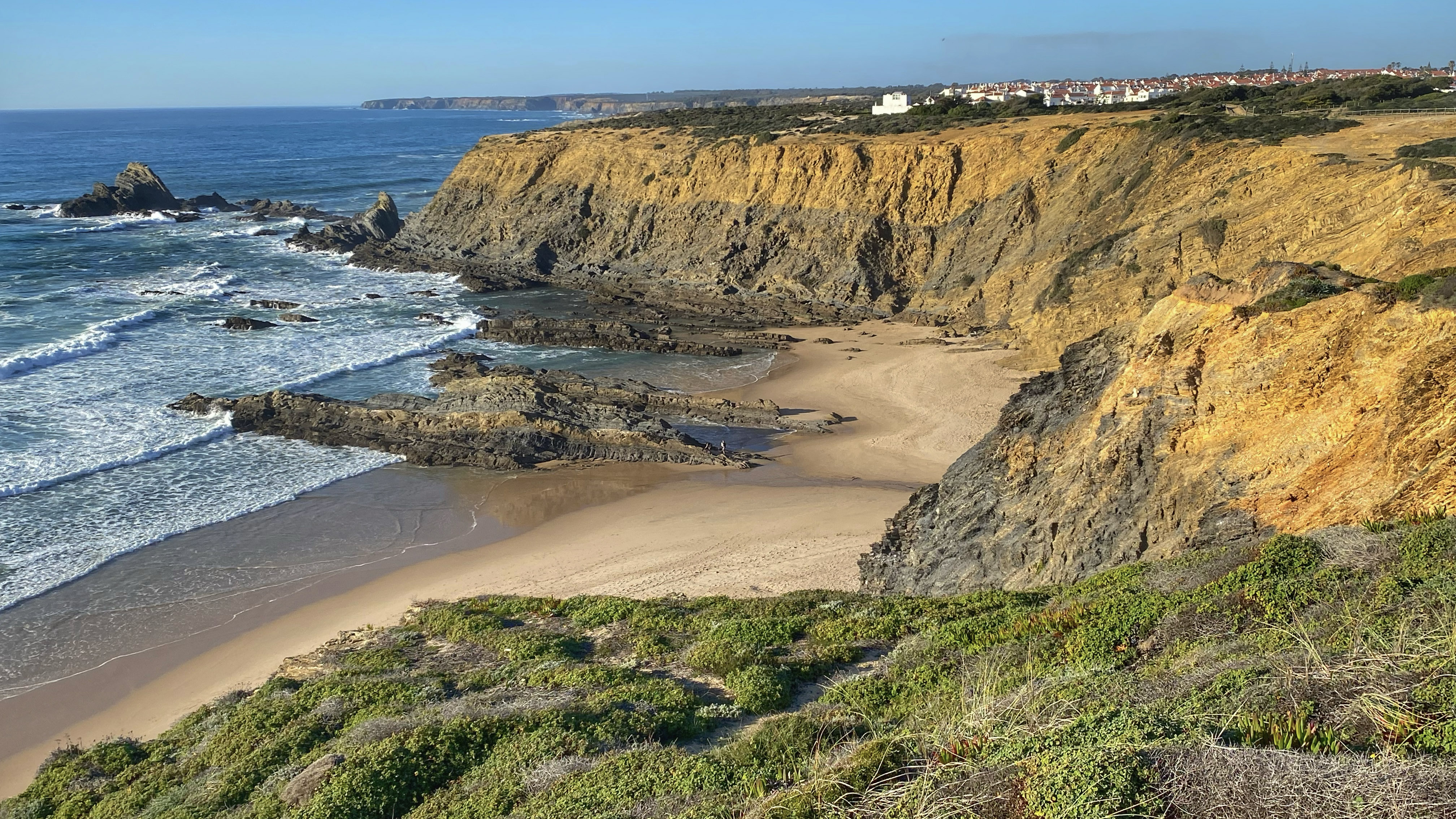

Portugal is a small but very beautiful country in the far west of Europe. When you visit Portugal, you can look forward to a mix of diverse experiences: stunning landscapes, a wealth of cultural attractions and a rich history, as well as world-famous cuisine. Add to that the hospitable locals and a wonderful climate, and you have the perfect destination for a holiday, where everyone will find something special to enjoy.
Hiking and walking tours are a wonderful way to explore Portugal. Walking through the country is a fascinating experience: there are picturesque coastal paths and wooden walkways winding through sand dunes alongside majestic cliffs, dirt tracks through flowering fields amongst the hills, ancient pilgrimage routes and Roman roads dating back to before the Common Era. It is on these hikes that you will discover the real Portugal and, more likely than not, fall in love with it!
The programms of trekking tours in Potrugal


Portugal
Distance 118 km
Duration
9 days
Portugal
Volcanic islands
Distance 18 km
Duration
6 days

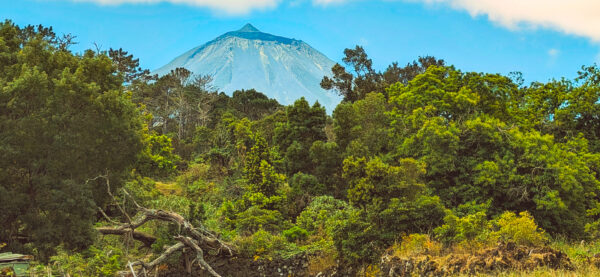
Portugal
Volcanic islands
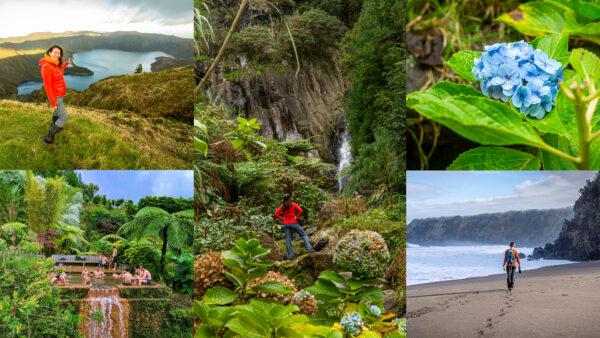
Distance 55 km
Duration
7 days
No program dates have been added yet. to the consultant and we will add convenient ones for you
Trekking and authors tours with KULUAR in numbers
553
participants
80
groups were led
94
reviews on the site
WHY YOU SHOULD TRAVEL TO PORTUGAL WITH US
Programmes that have been thought through down to the smallest detail and optimised
The programmes have been carefully designed to ensure you get the most out of your experience.
Comfortable accommodation
On all of Kuluar’s Portuguese trails, participants spend the night in cabins and do not carry heavy rucksacks.
Experienced team leaders
Our team leaders have been to Portugal many times and know the routes inside out.
Help with preparing for your trip
Our advisers will help you choose the right equipment and clothing.
The announced programmes will definitely go ahead
You don’t need to worry if you buy a ticket and the service is cancelled due to our fault. However, you must check with us before purchasing a ticket.
Discounts on equipment at partner shops
We work with many shops where our customers can buy equipment and clothing at a good discount.
The percentage of satisfied participants over the entire period is approaching 100%
And those rare occasions when participants’ expectations aren’t quite met – that’s a chance to become even better!
IF YOU GO TO PORTUGAL, GO WITH KULUAR!
What to expect when hiking in Portugal
Great natural diversity
Portugal is a small country, but thanks to the immense variety of its landscapes, even seasoned travellers will find it a delight to explore. The south of the country is famous for its luxurious, Instagram-worthy beaches, sand dunes and fields of wildflowers, whilst the north boasts low-lying but very beautiful mountains, as well as picturesque hills home to world-renowned vineyards. Furthermore, Portugal boasts dense relict forests, clear rivers and lakes. And the natural beauty of Madeira and the Azores is so captivating and unique that it deserves a separate, in-depth article.

A very beautiful, but cold ocean
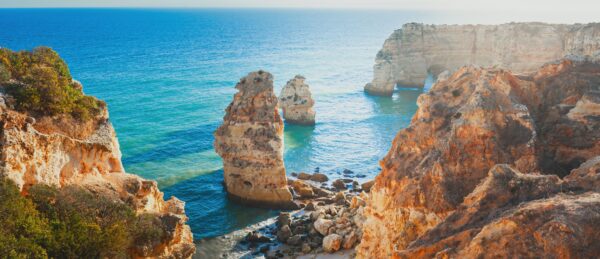
Portugal’s main natural attraction is, without a doubt, the Atlantic Ocean, along which there are countless walking routes. Thanks to the constantly changing scenery, you’ll never tire of walking along them, even on long trails. The country boasts plenty of both wide sandy beaches and steep rocky shores, which look as if they were made for photographs. The total length of the coastline is almost 1,800 kilometres! Portugal is also famous for having the world’s highest waves, making it a true paradise for surfers.
That said, not everyone is brave enough to go swimming in Portugal. The fact is that the water here is noticeably colder than in the ‘neighbouring’ Mediterranean Sea. Even at the height of summer, the water temperature rarely rises above 20–21 °C. One exception is the Algarve region in the far south – it is usually 3–4 degrees warmer there than in the north-west of the country. In Madeira and the Azores, the water temperature is higher, allowing for comfortable swimming from around July until mid-autumn.

Short and long walking routes
There are a great many walking routes throughout Portugal, and they are traditionally divided into long and short routes.
Grande Rotas (abbreviated to GR) – long routes that take more than one day to complete. They are usually marked with red and white stripes. Some long-distance walking routes stretch for hundreds of kilometres and take several weeks to complete.

Pequena Rota (PR) – short routes that can be completed in a few hours. They are marked with red and white stripes.
When choosing a route, bear in mind that many long routes are not properly maintained, so you may find yourself stuck in impassable thickets or windfall and be forced to turn back. They are also often routed in such a way that you pass through built-up areas, whilst the most scenic spots may be left out. Therefore, when choosing long routes, we recommend using the services of guides. All Kuluar routes in Portugal are long, and our team leaders know them inside out.
Accommodation in hotels and guesthouses
In Portugal, you are not allowed to pitch tents outside designated campsites. And as the cost of staying at these campsites is quite comparable to the price of a night’s stay in hostels and tourist lodges, hikers usually opt for the latter. On our treks through Portugal, participants also stay in cabins. This means we can carry less kit than on a traditional hike, as well as having access to hot water and the internet. An added bonus: breakfast is usually included in the price. And in the evening, rather than spending time cooking, we head to one of the nearby eateries to sample local specialities.

The Fishermen’s Trail in Portugal – Rota Vicentina
The Rota Vicentina is a network of walking trails in southern Portugal. We will walk one of the most picturesque sections of the trail in the Alentejo region, from Odeseixe to Porto Covo, known as the Fishermen’s Trail and marked in blue and green. Our entire route runs along the coast. Over 9 days, we’ll cover around 90 kilometres along comfortable wooden walkways, sandy beaches and dunes, as well as rugged rocky shores. The route is incredibly scenic and ranks among the world’s most beautiful coastal trails. We’ll cover up to 22 km a day, so don’t expect this to be a particularly easy walk. And at the end of each day, we’ll be welcomed by another fishing village offering comfortable accommodation, fresh seafood and wine.

The Way of St James – from Porto to Santiago de Compostela
The Way of St James is an ancient pilgrimage route travelled by thousands of tourists every year. Its final destination is the cathedral in the Spanish city of Santiago de Compostela, where participants are awarded a certificate of forgiveness of sins. You don’t have to be religious to enjoy the trek. The Way of St James offers the chance to enjoy the stunning scenery of two countries – Spain and Portugal – whilst also taking a look into your inner world, as there is plenty of time for reflection during the long walks. Participants cover up to 30 km a day, so it’s very important to choose the right, comfortable footwear. We spend the night in special pilgrims’ hostels – albergues.

Hiking on the island of Madeira
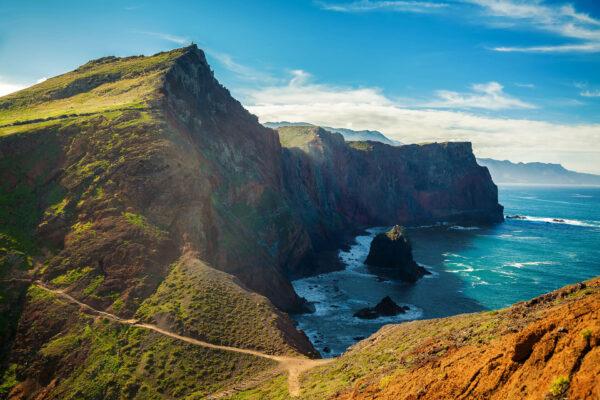
Madeira – the island of ‘eternal spring’, resembling a vast botanical garden. The conditions here are ideal for trekking: temperatures remain between 18 and 25 °C all year round. Madeira boasts high, picturesque mountains, whose peaks rise high above the clouds, dense mist-shrouded forests, cosy villages nestled on the hillsides, and, of course, the majestic ocean, visible from almost every point on the island. Our trekking programme in Madeira is carefully planned and packed with activities: over 9 days, participants will cover 70 kilometres and see all the main sights of this remote corner of Portugal. Join us!

When is the best time to go hiking in Portugal – seasons and weather
Portugal is characterised by a mild Mediterranean climate with a strong oceanic influence. Thanks to this, winters here are relatively mild, whilst summers do not suffer from the same sweltering heat as in neighbouring Spain. A distinctive feature of the local climate is the high number of sunny days. On average across the country, this can reach 300 a year, making Portugal the sunniest country in Europe and a wonderful place for hiking, which is becoming increasingly popular every year.
Different regions of Portugal have distinct climatic characteristics. For example, in the northern part of the country, where the terrain is predominantly mountainous, temperatures are slightly lower throughout the year. And there is more rainfall there.
The southern part of the country is warmer and drier. Even in winter, daytime temperatures here can reach +25.

As for the best time for hiking in Portugal, it is spring and autumn. In summer, it can be too hot for backpacking, whilst in winter it is cold, windy and damp (except in the Algarve – the southernmost region).
The cost of a trip to Portugal
The total cost of hiking trips in Portugal is made up of three components:
- Cost of the programme
- Airfare
- Additional costs along the route
The cost of the Camino de Santiago programme is €1,430, the Fishermen’s Trail programme is €930, and the Madeira trekking programme is €1,180. In all cases, the prices quoted are for the best value packages, which include all necessary transfers as per the programme and accommodation.

Additional expenses on each of the three itineraries will amount to around €250–350 per person. These consist of meals in cafés and restaurants, paid guided tours and admission to attractions, as well as spending on souvenirs.
How to get to the starting point of the hike
Our walking tour along the Way of St James starts in Porto, the fishermen’s trail hike in Lisbon, and the trek in Madeira in Funchal. Groups will meet at one of the hostels or albergues; the exact meeting point and the team leader’s contact details will be provided to participants 7–10 days before the start of the trip. It is advisable to arrive the day before the start or early in the morning, as on the first day we will be taking a tour of the cities where the tours begin.

You can fly to Lisbon on direct flights operated by Wizz Air and SkyUp Airlines from neighbouring countries, or via connecting flights with other European airlines. You can only reach Porto and Funchal via connecting flights.
Frequently asked questions about the region
Safety in Portugal
Portugal is one of the safest countries in the world. According to the ‘Global Peace Index’, which measures a country’s level of safety, Portugal ranks fourth in the world, behind Iceland, New Zealand and Austria. This is a very good result, but you shouldn’t let your guard down. Pickpocketing is very common in major cities (Lisbon, Porto), particularly in areas frequented by tourists. We therefore recommend keeping your valuables and documents in safe places and staying alert.
Visa
Ukrainians do not need a visa to visit Portugal; a biometric passport is sufficient. Citizens of other countries must apply for a Schengen visa. You can check with our advisers regarding the entry requirements for Portugal for residents of your country.

Portuguese cuisine
Unsurprisingly, Portuguese cuisine is centred on fresh fish and seafood: sardines, tuna, mackerel, sea bass, octopus, crabs, squid and shellfish. Surprisingly, the Portuguese’s favourite fish – cod, or bacalhau as it is known here – is not found off the country’s coast, so it has been imported from Norway and Iceland for centuries. There is a vast array of dishes based on bacalhau, which vary from region to region.
The pastries and desserts in Portugal are absolutely delicious. Perhaps one of the best known is the pastel de nata – a puff pastry filled with custard.

Portuguese wines deserve a special mention. The country has several provinces renowned for their vineyards (the Douro region is particularly famous), which is why local wines are so popular. Port wine – a fortified wine named after the city of Porto – is known and loved all over the world. The Portuguese are also very fond of Ginjinha, a delicious cherry liqueur.
All in all, Portuguese cuisine is so delicious and unique that you could visit the country on a culinary tour, spending your entire trip hopping from one restaurant to another, savouring the most delicious local delicacies. On our tours, you’ll have the chance to experience this kind of holiday!
Sights, architecture, cultural heritage
Portugal has a long and eventful history and is renowned for its rich cultural heritage spanning various eras: its numerous castles, palaces, cathedrals and monasteries attract tourists from all over the world. Even in tiny fishing villages, you’ll find real aesthetic delight as you stroll through the cobbled streets lined with neat little white and blue houses. And in many towns, you can see UNESCO World Heritage Sites (there are 17 in Portugal in total).

The country’s largest cities – Lisbon and Porto – are particularly appealing to culture lovers. Even a few weeks wouldn’t be enough to see all their sights. On our walking tours in Portugal, we set aside the first day for exploring these cities.
Among other cities, the following are worth mentioning:
- Sintra is famous for its palaces and the Moorish Castle. Be prepared for crowds of tourists.
- Évora – a veritable city-museum
- Braga – home to the Bom Jesus temple complex and other notable landmarks
- Guimarães – has a remarkable historic centre
- Obidush – a town with an impressive castle and the country’s ‘chocolate capital’
- Aveiro – the Portuguese Venice
Of the island towns, we recommend visiting Funchal on Madeira and Angra do Heroísmo in the Azores. In fact, virtually every town and village in Portugal, from a small fishing village to the capital, Lisbon, has its own unique charm. Come and see for yourself!

Where to find inspiration: books and films
Before visiting Lisbon, we recommend reading Pascal Mercier’s novel *Night Train to Lisbon*. You might also want to watch the 2013 film of the same name.
"Lisbon: What a Tourist Should See" is an excellent guide to the city. It was written by Fernando Pessoa in the first half of the 20th century, but it remains as relevant as ever. As well as descriptions of individual sights, the book contains a wealth of fascinating stories from the author.

If you speak English, we recommend reading *Journey to Portugal* by the Portuguese writer and Nobel Laureate in Literature, José Saramago. Fans of historical novels will enjoy another book by the same author, *The History of the Siege of Lisbon*.
Photos and videos


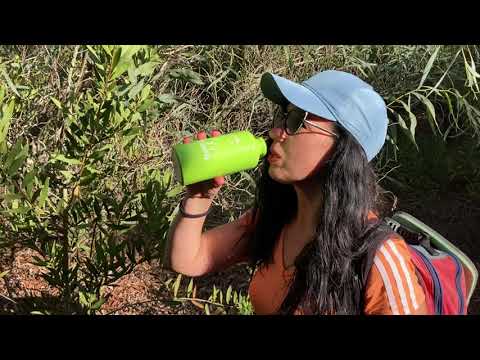
The impressions of our participants after trekking in Portugal with Kuluar
Total impressions of participants: 1829
Route reviews The impressions of our participants after trekking in Portugal with Kuluar : 12
Route reviews The impressions of our participants after trekking in Portugal with Kuluar : 12
short

It was a hike where everything came together
Author: Olena
🌋 Author's tour to the Azores: PIKU, SAO GEORGE, FAYAL
It was a tour that had it all: breathtaking nature, active recreation, the ocean, delicious food, great company, comfortable accommodations, and professional organization. It’s a trip I’d highly recommend and will remember for a very long time.
The tour was incredibly well-planned: a packed itinerary, smooth logistics, and a wonderful balance between hikes and relaxing on the coast.
I was particularly impressed that the experience didn’t lose its luster as the days went by—on the contrary, every new island, trail, and landscape amazed us even more.
I’d like to give special mention to the organization. Any unforeseen circumstances were handled quickly and professionally. It was clear that our tour leader, Tanya Franchuk, lives in the region and knows all the local ins and outs, routes, logistics, and weather nuances inside and out, which allowed us to make the most of every day of the trip.
A pleasant bonus was the well-chosen hotels with stunning views and the chance to sample the local cuisine.
The climb to Pico will remain a special memory. It was an incredible experience. A big thank you to Tanya for her support, motivation, and well-thought-out plans. I definitely want to go on the Azores 2.0 tour
short

The Incredible Azores with Kuluar
Author: Yevheniia Denysiuk
🌋 Author's tour to the Azores: PIKU, SAO GEORGE, FAYAL
An incredibly exciting, adventure-filled custom tour of the Azores, covering the three islands of Faial, São Jorge, and Pico. Stunning scenery, delicious local cuisine, and super comfortable hotels with breathtaking views right from your window! For me, this tour exceeded all expectations! The hikes are varied, and each island has its own unique atmosphere. Every day feels like a page from an adventure book! The level of comfort, organization, and program richness is top-notch. Active hiking every day (trekking across volcanoes, walking through craters, and feeling the Earth’s history unfold) + swimming in a wide variety of stunning locations, lunches, dinners, and uniquely charming cafes! Plus, you can visit a cheese factory. We saw all the processes and details of cheese-making, places where coffee has been grown for generations, and chatted with master weavers; we also visited a winery where they make wine from volcanic grapes! And of course, the whales—that was a dream come true for me! Eight days of adventure with Kuluar—it’s the best thing that could happen!
short

Thanks for the awesome tour!
Author: Daria Korshunova
🌋 Author's tour to the Azores: PIKU, SAO GEORGE, FAYAL
Thanks for the awesome tour! Tanya is wonderful, and my girls are the best!


