
The phenomenon known in the West for a long time called Via Ferrata is still a novelty for us. It's a shame... Via ferrata is a really interesting outdoor activity in the mountains, as well as a fairly safe way to get to viewpoints that only experienced climbers have ever seen before.
Of course, there are nuances and warnings: the route will be safe only if you follow the rules, have certified equipment and the right shoes.
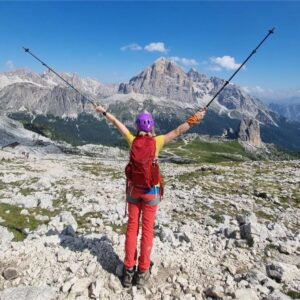
KULUAR Club, keeping pace with Western trends, has created for you the Via Ferrata in the Dolomites route, which is quite accessible to beginners and will be of interest to experienced travelers. This is a real mountain park among the breathtaking landscapes, where you will definitely get bright positive emotions and be captivated by incredible beauty! But first, we suggest that you familiarize yourself with the history, theory, and our tips for this type of activity.
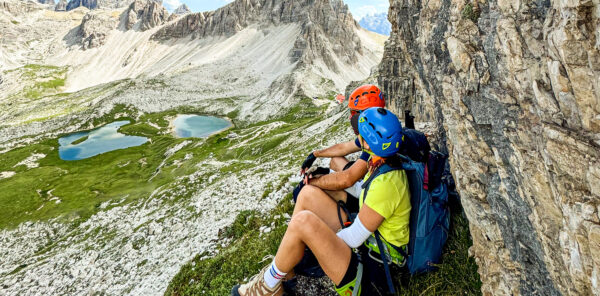
The First World War and its thousand-kilometer-long fronts across the Alps gave rise to the Iron Trails movement, which is how this concept is literally translated from Italian. The positions of Austro-Hungarian troops and enemies were located at considerable altitudes (over 3,000 meters above sea level), and in inaccessible rocky places. And given the fact that the frontline had been standing for 2 years or more and tens of kilometers of short-lived rope handrails had to be constantly replaced... the soldiers realized that metal cables, steel cable and auxiliary supports were a completely different level!

Lucy and Pauline Rankin, members of the Scottish Women's Mountaineering Club, 1908.
Even before the war, the inhabitants of the mountainous areas made trails and passes, laid handrails and stairs, but it was only in the last century that the via ferrata began to be used seriously. "And what about now?" - you may ask. Taking into account all the Alpine countries, it is safe to say that the total number of ferrata is over 500!
The modern Via Ferrata is a rocky route laid along a permanently fixed steel cable that is stretched between metal stakes driven into the rock. To facilitate the passage of the "iron path," stairs are also installed, additional bridges and other metal structures are hung.
Thus, via ferrata can be called a unique and safe way to enjoy mountain scenery with a dosed portion of adrenaline. The difficult terrain increases this portion, because there are routes of high difficulty that can be a serious challenge for experienced climbers even in perfect weather. But more on that later.

There are several scales of difficulty for ferrata routes: Italian, French, Austrian, and two German scales (Hüssler and Werner). Most publications and guidebooks use the Austrian scale A-B-C-D-E with intermediate values, such as B/C.

Complexity characteristics:

It's interesting to know that in the design of a via ferrata, the first section of the route is usually the most difficult section of the entire journey. Thus, the hero who overcame it can be proud of himself - there will be no more difficult ones. However, always be careful and take care of yourself!
We should not forget about a number of natural factors that significantly complicate the route. Namely:
Despite some common features, via ferrata and rock climbing differ significantly in terms of technique, equipment, protection, and levels of difficulty.

Let's just say that simple ferratas are suitable for travelers without experience; medium/difficult level is within the power of those who have at least some rock climbing experience, but to overcome the most difficult ones, you need to first practice well in passing ferrata routes. Even for experienced climbers, the most difficult "iron trails" are not recommended without special training. There is no place to get ferrata experience in Ukraine yet, but there is definitely a place to practice climbing techniques for warming up. We'll tell you about climbing training places and via ferrata options outside of our country at the end of the article.

Speaking of "iron trails," they are usually laid out on a fixed, pre-prepared territory with a clear direction. At the same time, they are fully equipped with all the elements for climbing, which reduce technical complexity. Climbing, on the other hand, takes place without auxiliary structures (i.e., you have to make your own support points and belay) - on natural terrain or specially built climbing walls. Another difference is that ferrata routes usually lead horizontally with a moderate gain in height, while climbing routes lead vertically.
It is interesting to know that the easiest category of rock climbing is the 5th (not the 1st, as in mountaineering). In rock climbing, all routes are rated on a scale from 5 to 9 in terms of their difficulty in numerical terms and from "a" to "c" in terms of their lettering (subtype of difficulty). The difficulty of the route increases evenly with the category number. For a more accurate gradation, Latin letters are used in ascending order of difficulty. Thus, 6-b is easier than 6-c, and 6-c is easier than 7-a.
So now it's easier for you to navigate and not get confused by the difficulty categories that are used to mark climbing trails and assigned to ferrata routes.
The special kit includes a shock absorbing unit, a climbing helmet, 2 ropes with carabiners, and 2 loops (1 reserve). Let's take a closer look at this equipment.

The shock absorbing unit (energy-absorbing device) is the main element of the kit, its function is to absorb the energy of the fall, which, in turn, reduces the impact force on the climber's body and reduces the risk of injury.
Mountaineering helmet - protects the head from falling stones and hitting rocks.
Two ropes with carabiners are needed to attach a climber to a steel cable or other fixed elements of the route. These ropes have a certain length and are equipped with carabiners at the ends, as described above.

The central carabiner or loop is used to attach the kit to the climbing system (belt).
The backup loop is used for additional safety or on the route while resting and preparing for the next stage.

Gloves are a must-have piece of equipment. The hands of a ferruginous climber are constantly holding onto steel parts, so they need protection not only from calluses but also from small and dangerous burrs. In addition, in a variable mountain climate, even in summer, gloves can protect against hypothermia.
Appropriate shoes. For hiking in the mountains, we recommend hiking boots or mountain boots, but the ideal shoes for ferrata climbing are so-called trekking or rock shoes. The hybrid of rock and hiking boots not only provides the necessary flexibility and grip on the ferrata, but also ensures safety and comfort on the approach to the route thanks to its hard sole.
Safety system (belt). Adjustability and tightness of fit to the body. The most popular are combined systems that combine a lap and leg belt (for maximum safety and comfort).
For the possibility of stationary insurance in places of rest, most climbers take a 120-centimeter stitched loop with a carabiner at the end with them to difficult ferrata.
Clothing should be comfortable, durable and suitable for the weather conditions. It is important to use a multi-layer principle so that you can adapt to temperature changes.

Backpack. A 20-30 liter backpack is enough to carry additional equipment, water, food, and personal items. It should have mounts for a helmet and trekking poles, as well as convenient quick access to things.
Drinking system or water bottle - to maintain hydration during the ascent.
A personal first aid kit should contain components in case of injury (including bandages and painkillers).
Sunglasses and cream.
Headlamp: preferably shockproof and waterproof.
Rual Amundsen, a Norwegian polar explorer and record-holder, the "Napoleon of the polar countries," said that unpleasant adventures are just a consequence of a lack of planning. Don't forget that a dozen minutes devoted to route planning can turn into hours of savings in the mountains. Whatever you say, you should start with quality and proper preparation.

The Via Ferrata requires not only physical endurance, but also special skills that can be developed even in urban environments - at a climbing wall or while going to climbing terrains. Regular climbing training helps you get used to heights, strengthens the relevant muscle groups, and builds endurance. Of course, by simulating different situations, you will also master the technique of safely securing your safety equipment, learn how to use different types of carabiners, and even how to properly fall from a height. You can't do without an experienced instructor, because the correct technique and the basics of self-insurance are sacred!
Rock climbing in Korostyshiv with the KULUAR club is a program that will be interesting for everyone, including beginners, families with children, and aksakals. In 2 days you will learn the basics of climbing, take a master class in tying tourist knots and have a lot of fun. Believe us, routes of different difficulty levels will definitely not scare you anymore.
Speaking of longer courses, we recommend the Hyperion climbing wall to Kyiv residents. The people from Kuluariv also took them and were satisfied.
Adrenaline is pumping, doubts are receding, and hands are fastening the carabiners to continue climbing the steep cliff. Every muscle and every nerve is working... concentration is at its limit, and there is silence and beauty around. And now you have reached the goal! Hurrah! You admire the mountains that few people have seen and enjoy the moment. Believe me, you will remember this action for a long time...

In the Brenta Dolomites, on the Rosengarten (Catinaccio) mountain range, on the outskirts of Lake Garda - and almost everywhere else in the Alps - there are equipped and safe ferrata routes. So you can admire the most beautiful mountains in the world from the most unexpected angles. Are you ready for an adventure? We offer you the "steepest" equipped trails in Europe.
The Via Ferrata Intersport Klettersteig, Donnerkogel is a gem of the Austrian Alps. The route passes through amazing rock formations and offers beautiful views of the Dachstein massif and Lake Gosausee. The panoramas here make you feel as if you are on top of the world. The main highlight is the 40-meter suspension bridge. You will be overwhelmed with emotions here!

The Via Ferrata through the Galleria Lagazuoi tunnels is the only one in the world that passes through the entire 300-meter wall of the World War I catacombs, where the front between Italy and Austria-Hungary once passed. During the route, you will find a historical installation and interesting information about the events of a century ago. You should definitely try this route with KULUAR - a lot of beauty awaits you!

Via Ferrata Delle Aquile, Paganella. Do you want to climb to the heights where eagles fly? Then you are at the right place - above the sky here 😉 Located in the picturesque Paganella region in the Dolomites, it impresses with its breathtaking views, unique technical sections and unforgettable impressions that last a lifetime. "The Trail of the Eagles" is exactly how Ferrata delle Aquile is translated. Welcome to the sky!

Via Ferrata La Clapière is located in the picturesque Val d'Isere in France and is one of the most unrivaled routes in the region. It attracts both experienced and novice riders looking for an unforgettable adventure among majestic mountain peaks. La Clapière offers a unique combination of technical challenges, incredible views and adrenaline rush.

Via Ferrata Grünstein, Grünstein - this route is located in Bavaria, near Lake Königssee. The most beautiful landmark in Germany can be seen from all angles. Surrounded by mountains and forests, the scenery here is simply divine.

Via Ferrata Le Bocchette, Madonna di Campiglio is undoubtedly the most famous and one of the most difficult via ferrata in the entire Dolomites. Located on the Brenta massif, it attracts travelers from all over the world with its stunning views, technically challenging sections and unique highland atmosphere. One of the main advantages of the route is the incomparable panorama of the Dolomites, including the Brenta massif, glaciers, lakes and deep valleys.
The Via Ferrata Rino Pisetta, Lake Garda, is considered one of the most difficult in all of Italy. In some places, the slopes are so steep that only the strongest and most courageous can walk here. Once you get to the top of Piccolo Dain, you will see the Valle dei Laghi valley with all its wealth in front of you. It is home to magical castles and the gorgeous lakes of Santa Massenza, Cavedine and Toblino.
Interesting fact: The Royal Trail of El Caminito del Rey, Malaga, Spain, is one of the most famous hiking routes in the world. Built back in 1901, it was used to transport goods and as a road between two power plants.

The name of the gorge through which it passes is EL Chorro, which means "the breakthrough" in Spanish. At that time, it was indeed a breakthrough. The ceremony was opened by King Alfonso XIII of Spain himself, hence the name of the trail - "royal". But the effects of natural factors over the centuries have made themselves felt, and due to the emergency condition that caused the deaths of several tourists, it was forced to close. Now it is a safe and fairly wide path with concrete supports and reliable handrails. By the way, it is already higher than the old route and is waiting for its desperate visitors. The views here are, let's say, breathtakingly exciting.
The routes of the Via Ferrata guarantee not only adventure and challenges, but also incredible views and the opportunity to feel harmony with nature.
With a large number of routes all over the world, everyone is sure to find the one that suits them best. Whether you choose the famous routes in the Dolomites or the adventures in Switzerland, or go on your own exploration along the mountain trails, every hike promises to leave an unforgettable experience and fill your body with dopamine. So let your next adventures be full of excitement, beauty and unforgettable moments, and KULUAR will always help you with this!
