Just look at the flag of Nepal and you immediately realize that this country is unusual, with its own characteristics, which distinguish it from the rest of the world. And many tourists come here to turn their minds, to look at the world with different eyes, to feel the freedom and, of course, to visit the highest mountains, to enjoy the incredible expanses of the Himalayas.
Nepal manages to surprise, make happy and fall in love with almost every guest. All its secrets of hospitality lie in the smiling people, ancient traditions, narrow streets, snow-white peaks. Here are some facts about this country that attract us and make us come back here again and again.
Nepal is the highest:
- Nepal is the highest mountainous country in the world, thanks to its location among the Himalayas (40 percent of the land is over 3,000 meters high).
- Nepal is home to 8 of the world's 14 eight-thousanders, including the highest point on the planet, Mount Everest, or Jomolungma (8848 m).
- Nepal has the highest percentage of the world's rural population, 86 percent. This is even higher than in the poorest African countries.
- The border between Nepal and China, which runs through the Himalayan massif, including four eight-thousanders (Everest, Lhotse, Makalu, Cho Oyu) is the highest in the world.
- There is also the deepest gorge in the world (Kaligandak Gorge), which separates the two octogenarians Annapurna and Dhaulagiri.
- Mount Annapurna I (8091 m) is the world's first eight-thousandth peak, which man climbed in 1950. But so far it is also the most dangerous peak (mortality rate of 32%).
- The airport in Lukla, which serves as a starting point for all trekkers and climbers in the Everest area, is considered the most difficult and dangerous in the world, as the runway is located at an altitude of 2860 m and is only 527 m long with a slope of 12 %, on one side rests against a rock, on the other goes into a cliff.
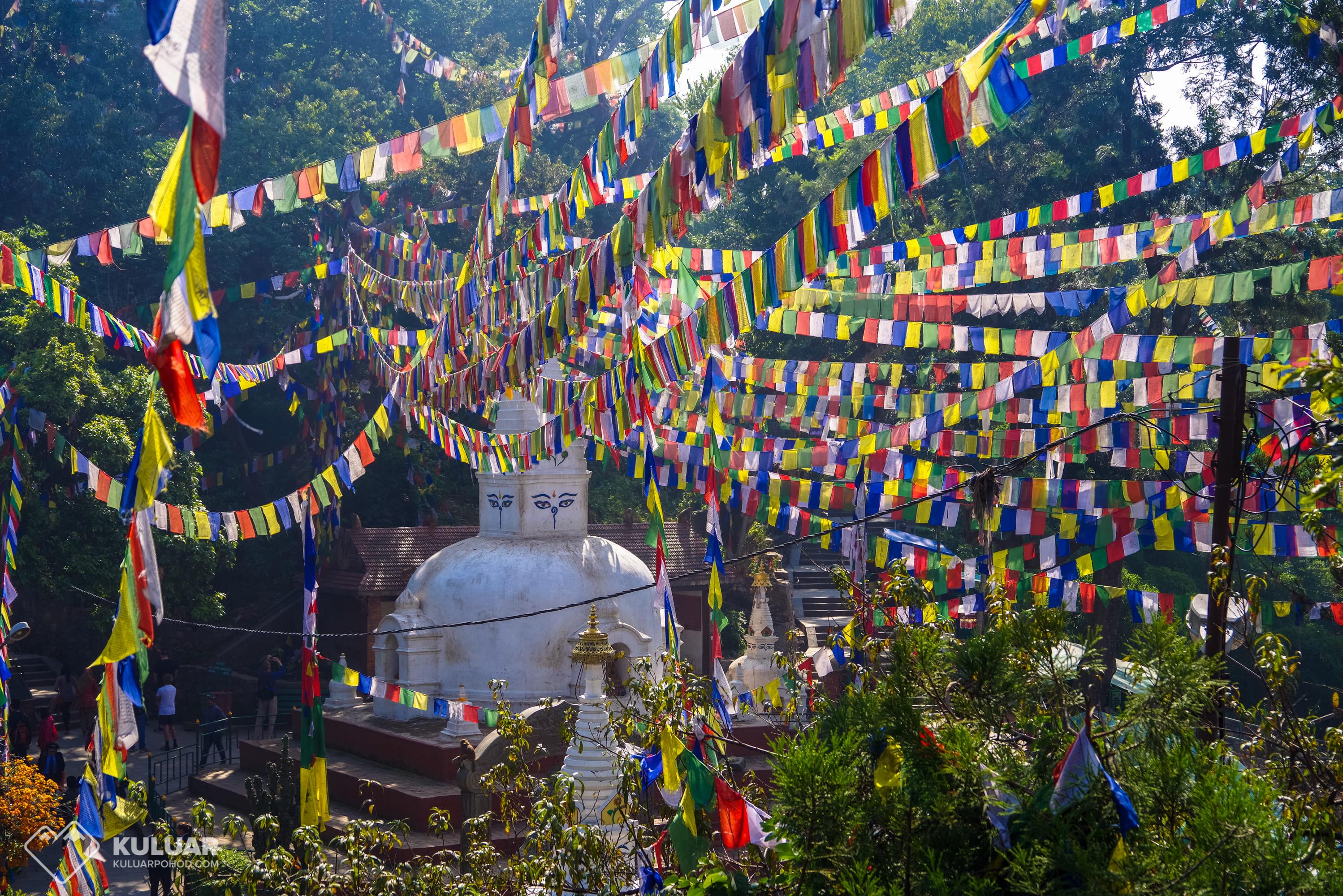
- In the capital of Nepal (Kathmandu) is the most visited Buddhist temple in the world - Bodnath Stupa, which is also one of the largest and oldest.
- And even the shortest man in the world was born in Nepal, his height was only 54.6 cm.
- The territory of Nepal, according to some data, is considered one of the most ancient inhabited lands on our planet. Scientists say that the first people appeared here about 30 thousand years ago.
- And, in my opinion, the Nepalese are the happiest people, despite their poverty and difficult living conditions. They are very friendly and always smile. Talk to your porter or another Nepali you meet while trekking - you'll never hear him complain about life, even if he has to live far away from his family and carry 30 kg every day over long distances.
And here are some more noteworthy facts that you will be interested to know and even personally check out on your next trip to Nepal.
Nepal - not like the rest
- The flag of Nepal is the only flag in the world that is not rectangular in shape, but composed of two triangles.
- Despite the relatively small territory (140.8 thousand km²), in Nepal you can walk through all climatic zones in one trek: from the hot tropics to the glaciers.
- Namastee is a special word for Nepal. It is how, with an extended "e" at the end and folded palms, it takes on its true essence. In its full sense, it means "The divine in me welcomes and joins with the divine in you. In Nepali life, it is used as a greeting and a farewell, as a request and an expression of gratitude, as a wish for a good day and a good mood.
- In Nepal there are living real goddesses Kumari are girls who have been selected according to 32 parameters and live in a palace until they come of age, performing their divine duties.
- Nepal is probably the only country in the world where Buddhism and Hinduism co-exist. Followers of both religions go to the same temples, often even praying to the same gods.
- In most cases, truck and bus drivers do not have auto insurance, because they are "protected" by a child's slipper or a bundle of hot pepper and lime hanging from the bumper. In addition, many cars have painted eyes to better see the road.
- There are no railroads at all in Nepal. All public trips are made only by buses, in which it is customary to carry all luggage on the roof. And often even the passengers themselves, if all those who want to go can't fit into the cabin.
- Traditional dishes of Nepal are mo mo (similar to our dumplings or dumplings) and dal bat (rice, lentil soup, and fried vegetables or meat). The portion of dalbat can be endless, as the rice will be added to your plate until you are completely full and refuse another addition.
- Even the hour difference in Greenwich Mean Time is not an even number of hours, but 5 hours and 45 minutes. Especially to show its independence from India.
- In addition, Nepal lives by its own calendar, which is 56 years 8 months and 15 days ahead of the world's Gregorian calendar. If you want to be in the future - go to Nepal, it's 2076!
- And all newborns are immediately written down the age of 1 year, to confuse the evil spirits that encroach on infants.
- Machapuchare (or Fishtail) is a sacred peak where the god Shiva lives and where people are forbidden to climb. Despite the fact that the main income of the country consists of tourists and climbers, you will not be allowed to climb this peak even with all the money in the world.
- Tamel is the cultural, historical and tourist center of Kathmandu. It is here that there are hundreds of basement manufacturing facilities for sewing the world's most famous brands of hiking equipment, which you can buy quite inexpensively and pack for the trek almost from scratch. (Link to article on buying gear at KTM).
Everyone finds something special about Nepal. It is difficult to understand what exactly it catches, but the fact that it does not leave anyone indifferent is certain. And the fact that many of them, having once visited this mountainous country, return there again and again proves it.
Do not believe it? Try for yourself all the beauty of Nepalese treks, the difficulties of the Himalayan mountains, the hospitality of the Sherpas and the peculiarities of Nepalese culture.