


But the borders were closed to me. So I just stood there, looking into the distance. I felt that it was “good” there and went down to the Tatopani hot springs. The seeds of my future trip to the forbidden kingdom of Lo were already born then…

After three intense years and several trips to Nepal, it was time to go to the Upper Mustang. This report is about the journey through the mysterious desert lands of the Lo Kingdom. Make yourself comfortable, there will be a lot of photos and a lot of text.
I’m sure not everyone has heard and not everyone knows what this forbidden kingdom of Lo is. Here’s a very short story.
The kingdom was founded by the brave warrior Ame Pal around 1380-1450. It was located on the Tibetan highland plateau and in its heyday occupied a much larger territory than it does now. The favorable location on the salt trade route between India and Tibet, as well as relatively fertile land, ensured the kingdom’s prosperity.
But this did not always last. In 1790, the king of Upper Mustang asked for Nepal’s help in the war with Tibet, and as a result, the kingdom was occupied by the Allies. Thus, Upper Mustang became part of Nepal. Royal power in the region was preserved until 2008. Now there is also a king, who is highly respected by the local people, but has no legal force in Nepal.
From 1960 to 1992, foreigners were not allowed to visit Mustang because it served as a stronghold of Khampa guerrillas fighting against the Chinese occupation of Tibet.
Today, there are about 30 villages in the upper Mustang, home to about 9,000 people. The capital of the kingdom, Lo Mantang, has about 1100 inhabitants in summer and about 300-500 in winter.
The unique traditions of Tibetan culture have been preserved here and many travelers go to the upper Mustang to get acquainted with the life and culture of the local population.
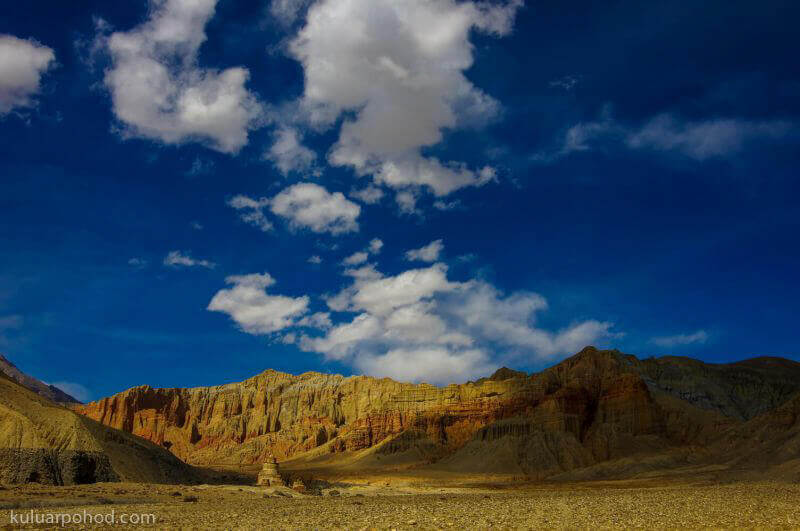
Getting into a Mustang is not so easy and quite expensive. This does not stop true lovers of the unknown. With the opening of the borders, a limit of up to 1000 tourists per year was set for foreigners, but now it does not work and in recent years, Mustang has been visited by more than 4000 tourists. On the one hand, it’s a lot, but on the other hand, twice as many people pass through the track to Everest in one month. In total, about 35,000 foreigners have visited Mustang in its history.
As you can see, the number limit is no longer a deterrent, only the high cost of the track remains. After all, a permit to Mustang costs $500 and is issued for 10 days. If you want to stay in the kingdom longer, you pay another $50 per day. In addition, you need to fly to Jomson (or drive a very long way on a very bad road) and take a local guide, without which you simply will not be allowed into the closed area. In general, the cost and difficulties are the only things that protect the kingdom from the flow of tourists now. The minimum number of participants in the expedition is 2.

I must admit that I do not want permit prices to be cheaper and conditions to be simplified, because in this case Mustang will very quickly become one of the most popular tracks in Nepal, it will become spoiled and its zest will be lost. I don’t want that. I still want to walk alone for hours in the Himalayas, not among crowds of tourists.
It’s hard to describe a trip to the Upper Mustang with the usual Nepalese word “trek” because it’s not just about amazing scenery, it’s also about unique culture, traditions and religion. To some extent, a trip to the upper Mustang necessarily contains elements of pilgrimage, ethnographic trip, research and, of course, trekking.
Our team was just wonderful – Eduard, Oleksandr, Ihor and me. All of us were experienced travelers who had come to Nepal not for the first time and had visited many countries before. Everyone had their own motives for going to the Upper Mustang, but they all had a common desire to explore the unknown and touch the forbidden.
I will skip Kathmandu and Pokhara in the report, you can read about them everywhere. Let’s move on to the airport, where we waited for two hours for the weather and the departure of our 15-seater plane to Jomson.
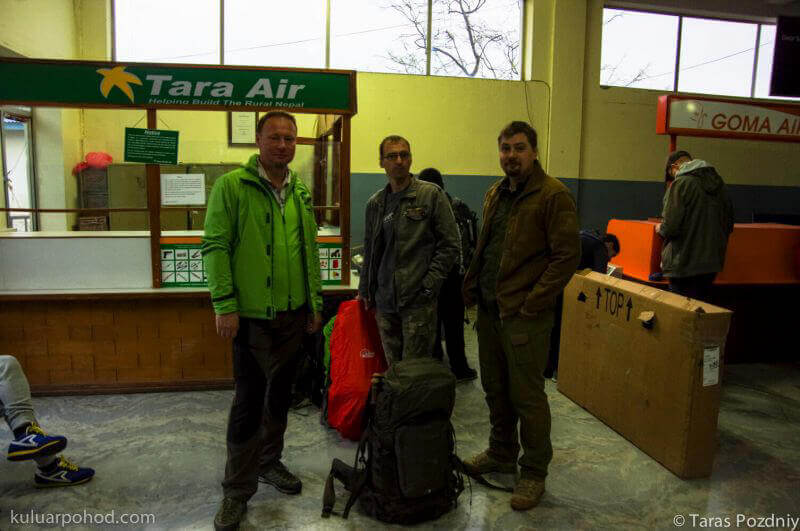
We waited for it. The flight is only 20 minutes, but what a ride! There is fog all around, the visibility is minimal and only from time to time, in the cuts of the clouds, the steep walls of the mountains are revealed. A month ago, two airplanes crashed here on two consecutive days. We believe in the theory of probability, so there shouldn’t be any accidents in the near future. We sit closer to the pilots, looking at what they are doing there.

A sharp turn, landing. Yay! The pilots did a great job. You can pat them on the back without getting up from your seat.
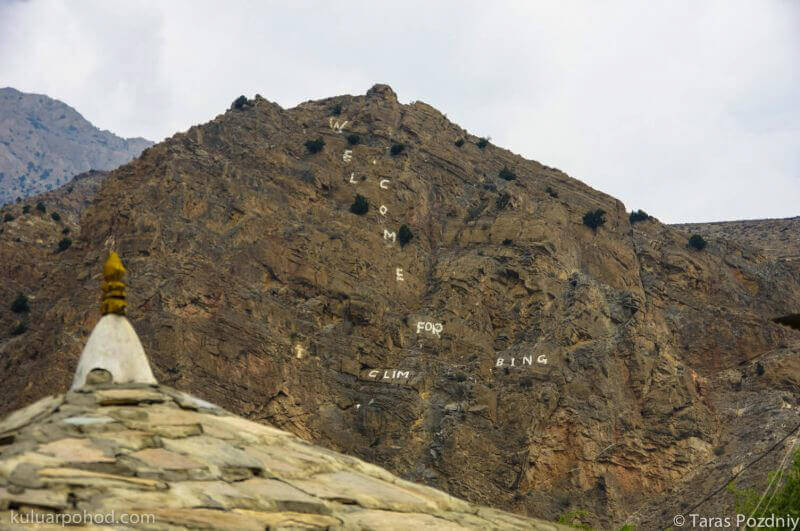
Jomson greets us with sunshine and a wonderful invitation: “Welcome for climbing”. Although we are not going for climbing, we are also going to the mountains.
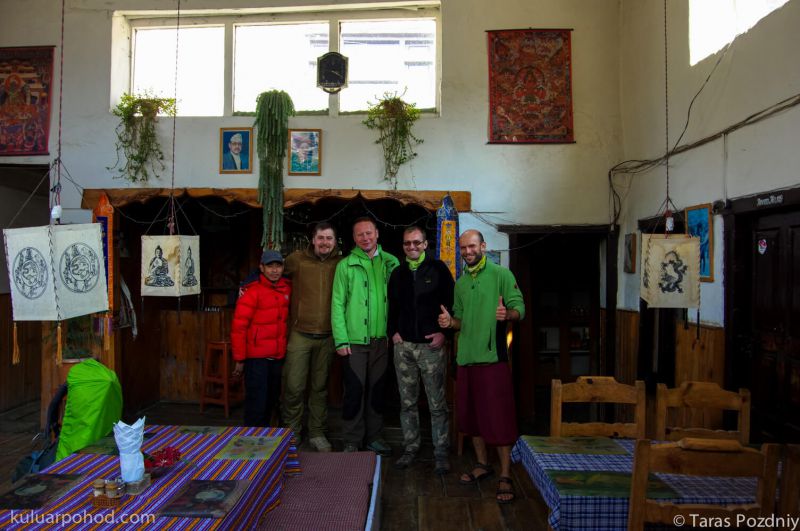
Our local guide Santosh is already here. We have breakfast, take a group photo and move towards Kagbeni, where the checkpoint to the closed kingdom of Mustang is located.
The road is good, highway. If you want, you can drive it in a jeep. What can I say, if you want, you can already drive a jeep to Lo Mantang, the capital of the closed kingdom. The good thing is that so far no more than 3-5 cars pass through per day.
We’re going on foot. We have no hurry, and it will help us acclimatize better.
On the way, we meet the first red, white, and black chortens, Buddhist religious buildings in the form of stupas. They can be either round or square.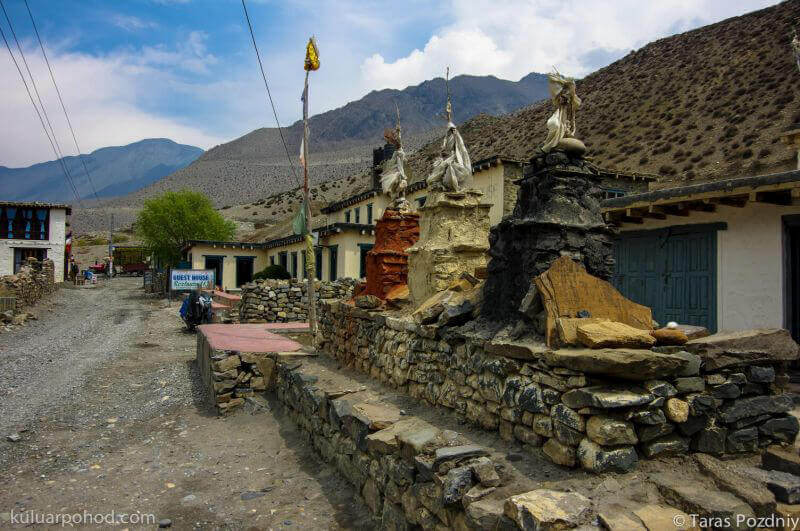
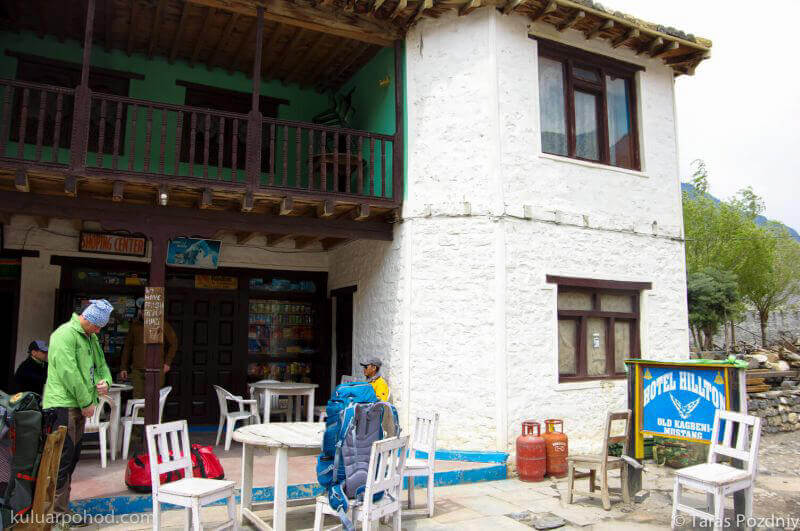
At the Hotel Hillton, it’s masala.
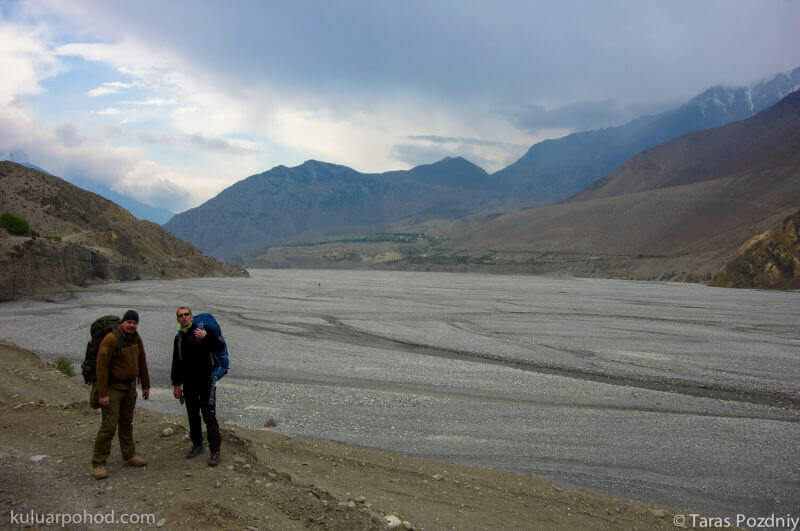
The road runs along the widest and almost dry channel of the Kali Gandaki. It’s scary to think about how the river floods during the rainy season. And now we can walk along its bed.
We arrived in Kagbeni quickly. We checked into the lodge, immediately drank a cup of homemade sweet apple cider and went for a walk.
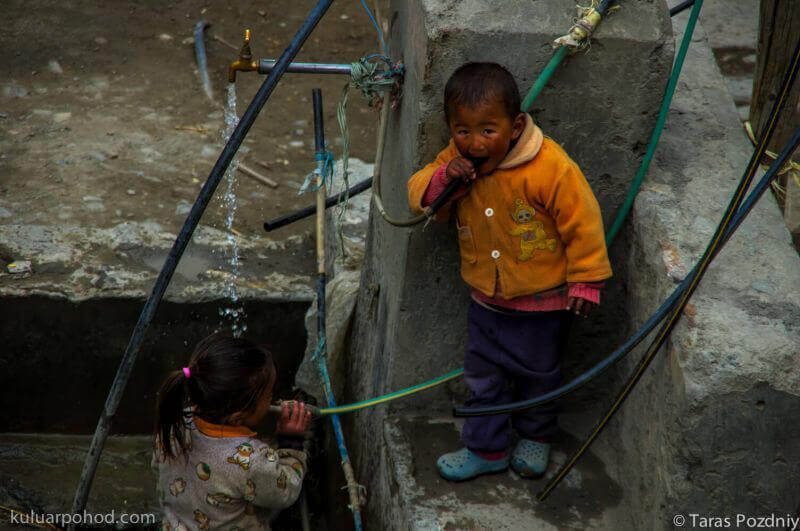
The kids are drinking water.
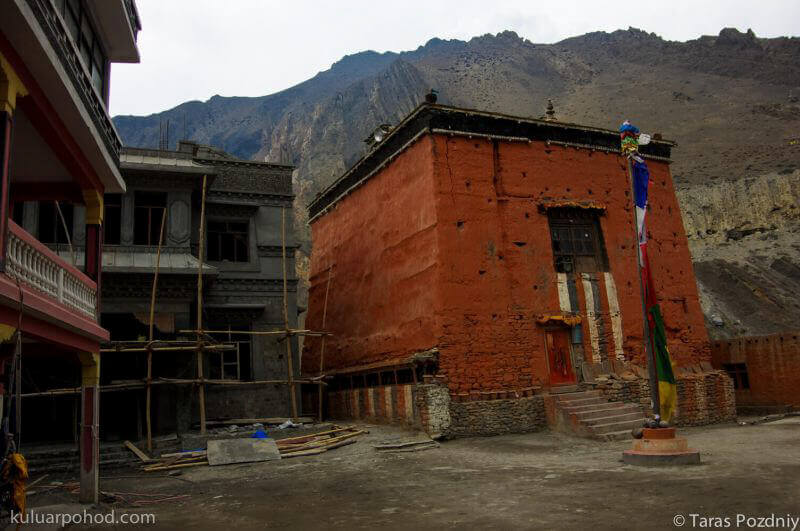
A local monastery. If you look closely, you can see holes in the walls – these are dwellings for pigeons. A new one is being built nearby.
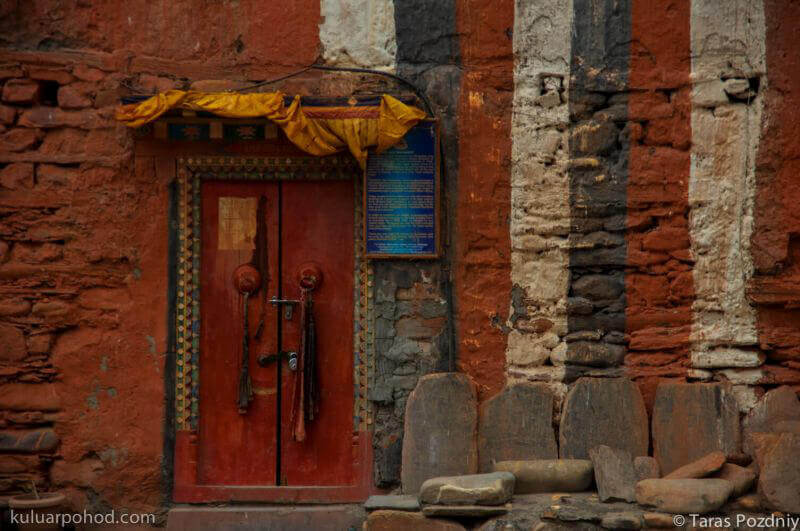
The door is locked in a special way. The key is for people, and the rag is for spirits.
We have some free time and decide to go to the nearest stupa on the hill. The hill offers great views of the green Kagbeni. It is noteworthy that down here (at an altitude of 2800-3000m), spring has already fully come into its own. While at altitudes above 3500m, this will not happen soon.
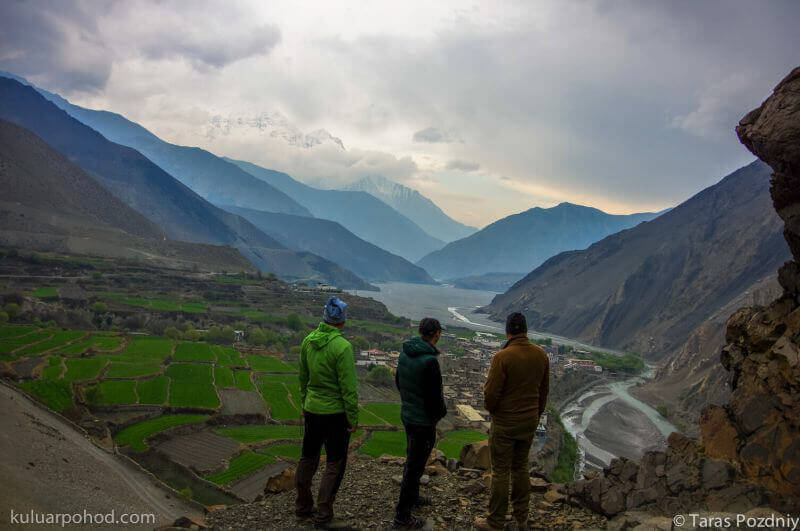
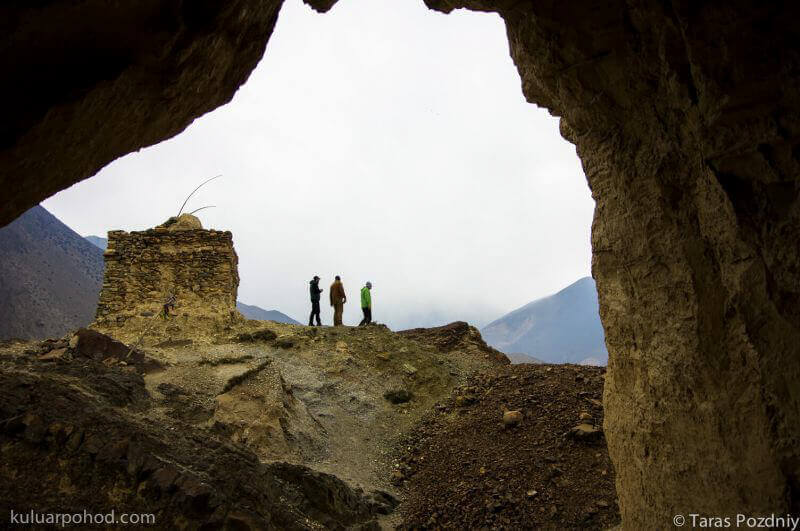
The men are looking around the neighborhood, and I’m running into the grotto and taking pictures from there.
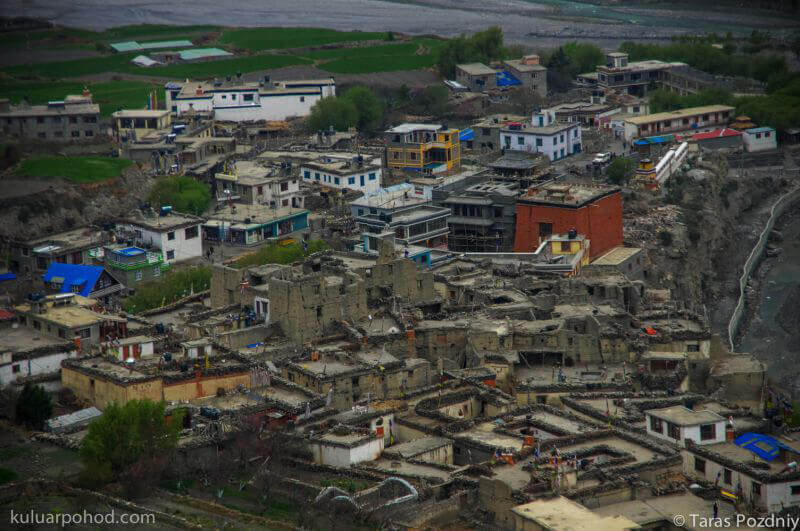
This is how Kagbeni looks from above. In the middle of almost every village in Mustang there is an old castle, around which houses grew over time.
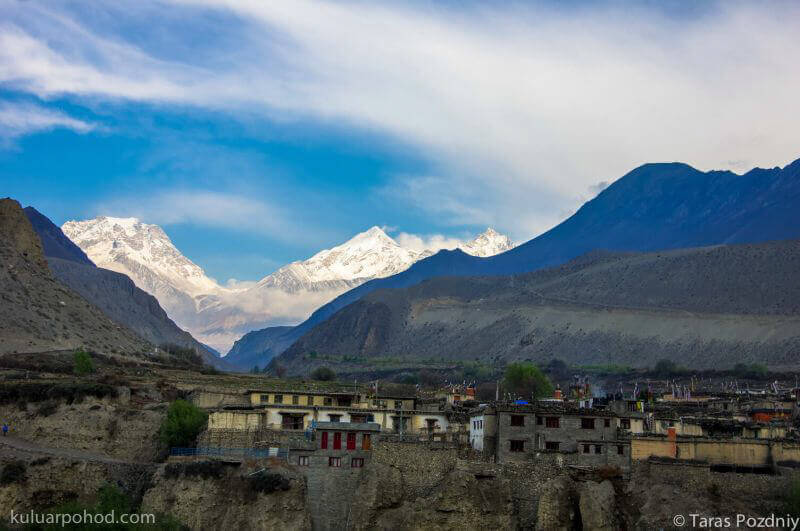
On the way down the hill, it started to rain lightly. But it didn’t stop us. We bought a bottle of local apple brandy and went to the other side of the river. From here you can see the Torong La Pass, the highest hiking pass in the world (5,416m). We passed it during the trek around Annapurna, and now we are enjoying the views.
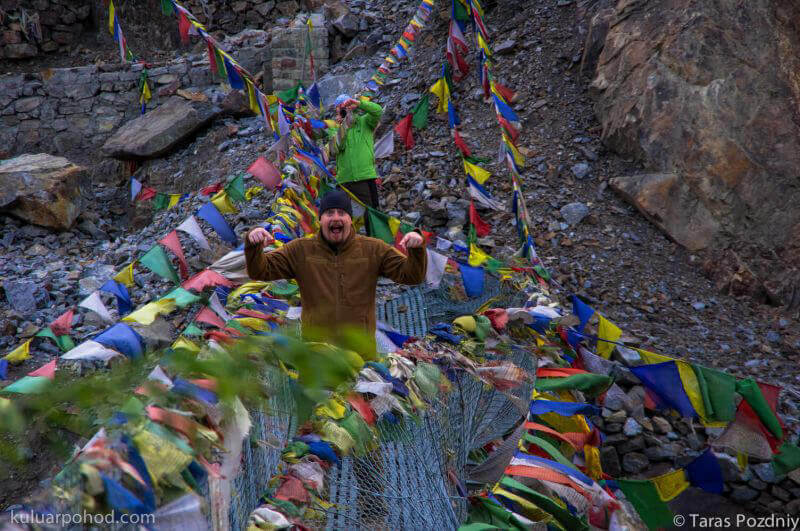
The river is very cold. Apple brandy is so disgusting that it’s hard to drink. But it warms you up a bit. We decided to go back by an old, abandoned bridge, hung with flags with mantras more abundantly than any stupas. Ihor expresses his emotions about this, Sasha takes pictures of him from behind, and I take pictures from the front.
In the evening, the last session of communication with the big earth. We connected to wi-fi, which is a thing that the upper Mustang doesn’t really know about and doesn’t exist there at all. We drank another glass of apple cider, had dinner and went to bed.
The next day, we are waiting for a checkpoint in the upper Mustang. We get our stamps in our “special permits” and ask them to put them in our passports for fun. They do. Today’s goal is the village of Chele, located at an altitude of 3100 meters.
In the morning, Kagbeni looks like this.
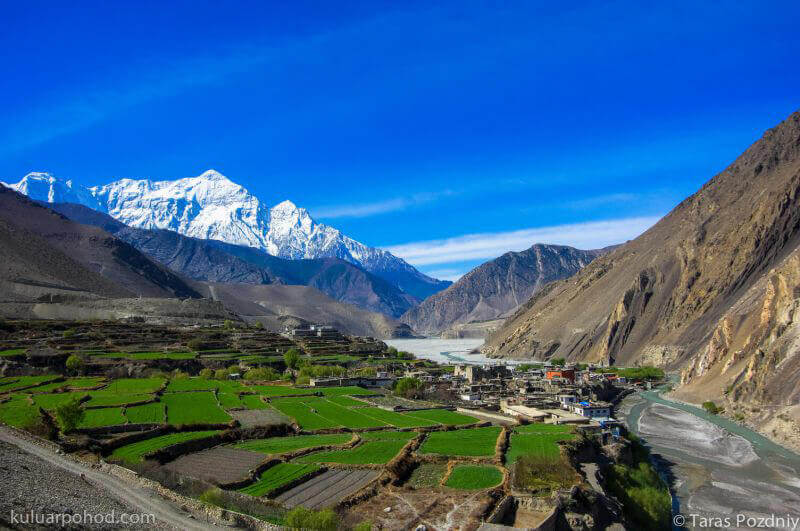
We walk along the road along the Kali Gandaki riverbed. Against the backdrop of Chusang we take a picture with the flag. It is a very beautiful canyon. I handed the camera to a passing aborigine who spoke little English. He took an incredibly crooked photo, probably the first one in his life with a DSLR. So I’m going to post it here.
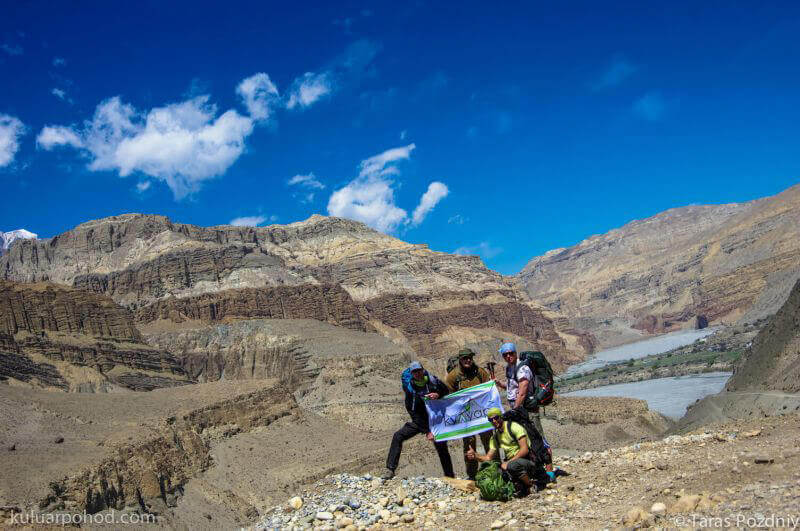
Chusang is located at the confluence of the Nari Khola into the Kali Gandaki. It is a picturesque village rich not only in landscapes but also in ammonites. We will return to it and to them.
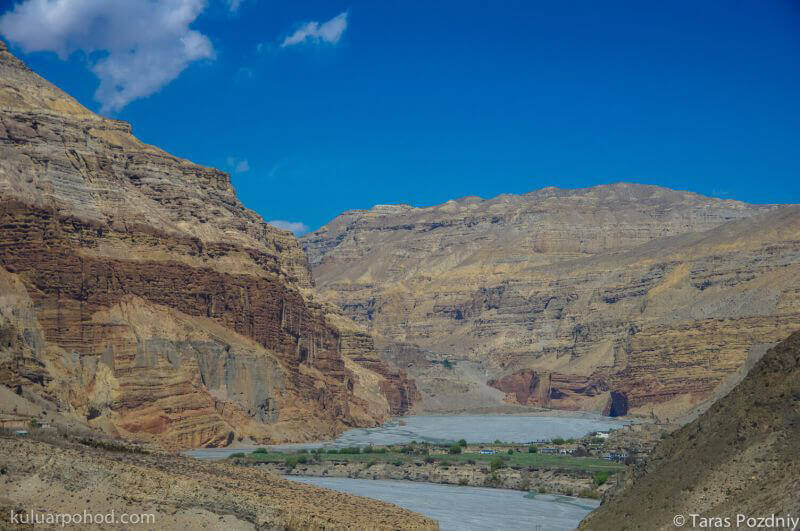
Roadside landscapes in some places resemble Cappadocia.
The first cave dwellings are on the way. There will be many more to come.

After Chusang, the road goes through the famous red canyon. We cross the bridge to the other side.
Sasha in front of the bridge. Or against the backdrop of red rocks. As you like.
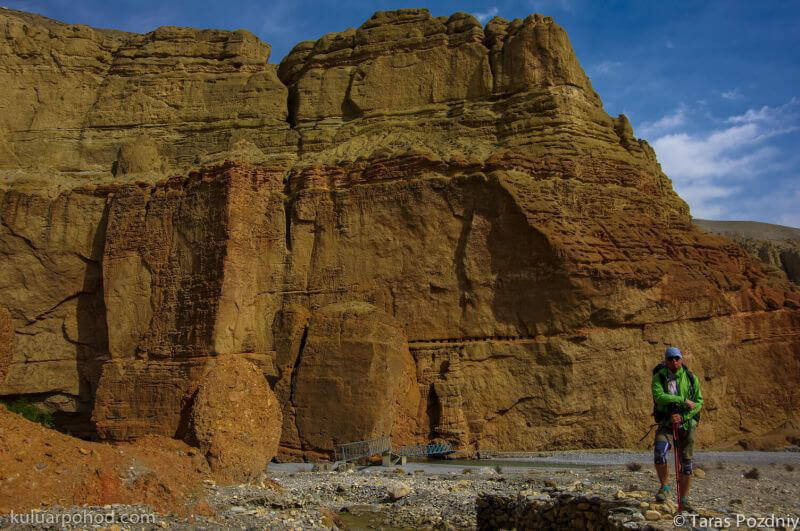
There is a small climb to Chele. It is not as steep as it may seem in the photo. The guys with Santosh are in front, I’m behind.
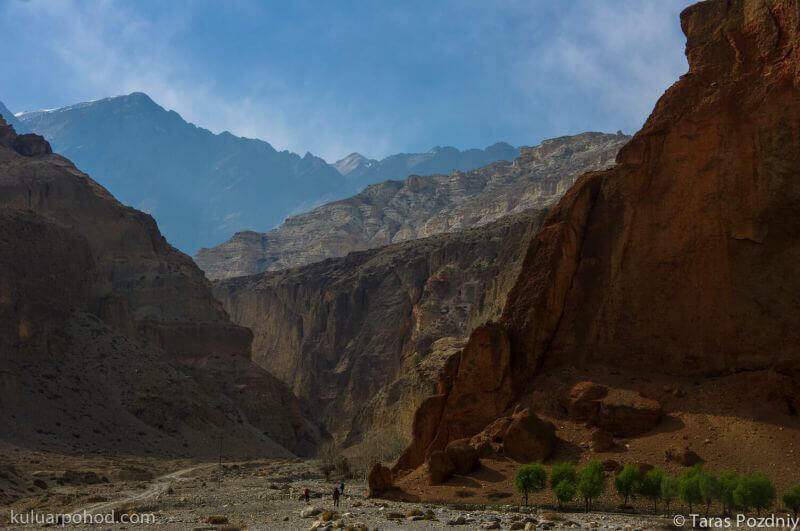
Typical roofs of any settlement in the upper Mustang. Firewood is hard to come by here, so they collect it wherever they can and dry it on the roofs. It looks very authentic.

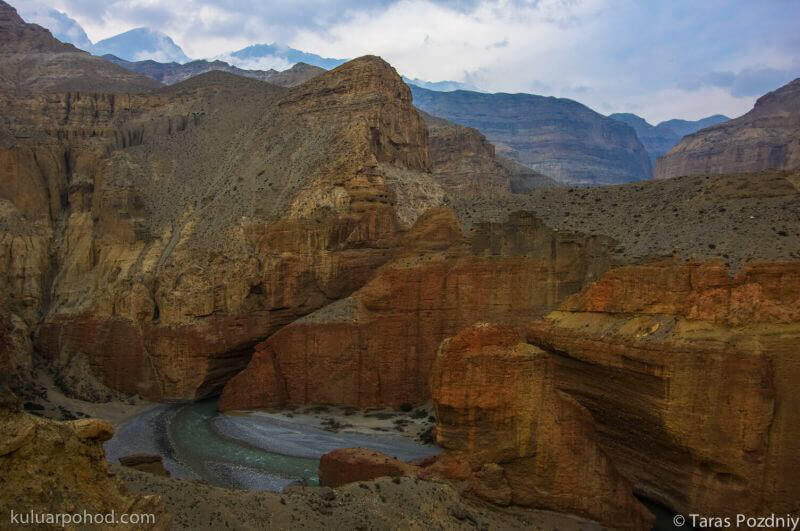
We went for a walk around the local neighborhood. Very impressive canyons, I must say. And Ihor takes much better photos than the locals.

The Kali Gandaki goes deep into the canyon, and we can’t go down there. Unless we try to walk along the channel, but that’s for another time.
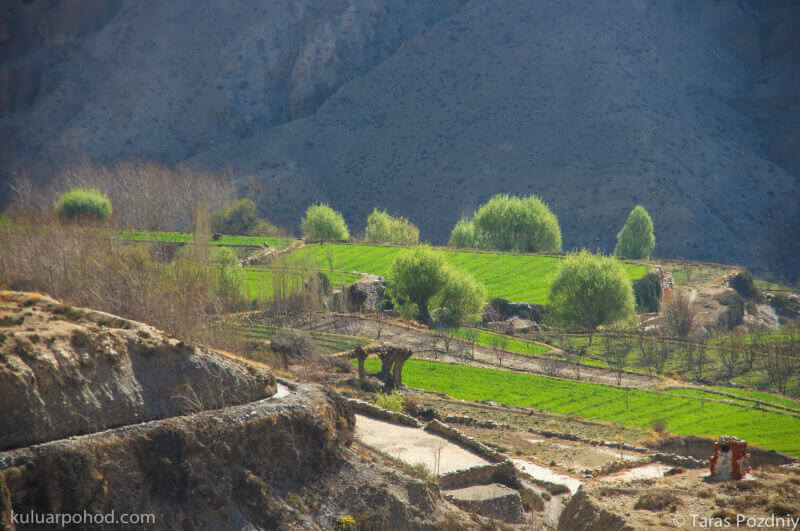
The locals have learned to squeeze the most out of their scarce land. All vegetable gardens are built on terraces, and the irrigation system is very sophisticated. A few hundred meters uphill there is a lake where a spring flows into a reservoir for collecting water. The water accumulates and, when the time comes, the dam opens (a couple of fallen stones are simply removed). The water is directed down through artificial channels, irrigating all the terraces. It is difficult, but there is no other way. The village looks green, and dwarf (in our understanding) apple trees are already blooming.
In the evening, we drink tongba. Tongba is a local low-alcohol drink served in a large half-liter vessel filled with grains of cooked and stewed millet. It is flavored with various spices. The taste is bread-like, slightly sour. When the first portion is finished, you just add hot water and wait a few minutes – the second portion is ready. Thus, you can sit very cozy all evening. I don’t know why, but I didn’t find any photos of the tongba, so I’m waiting for one of the guys to post theirs.
These were the first few days of the trip. Days during which, in fact, we hadn’t seen anything special yet. But we didn’t know about it yet and never stopped being surprised. It’s going to get more interesting!